


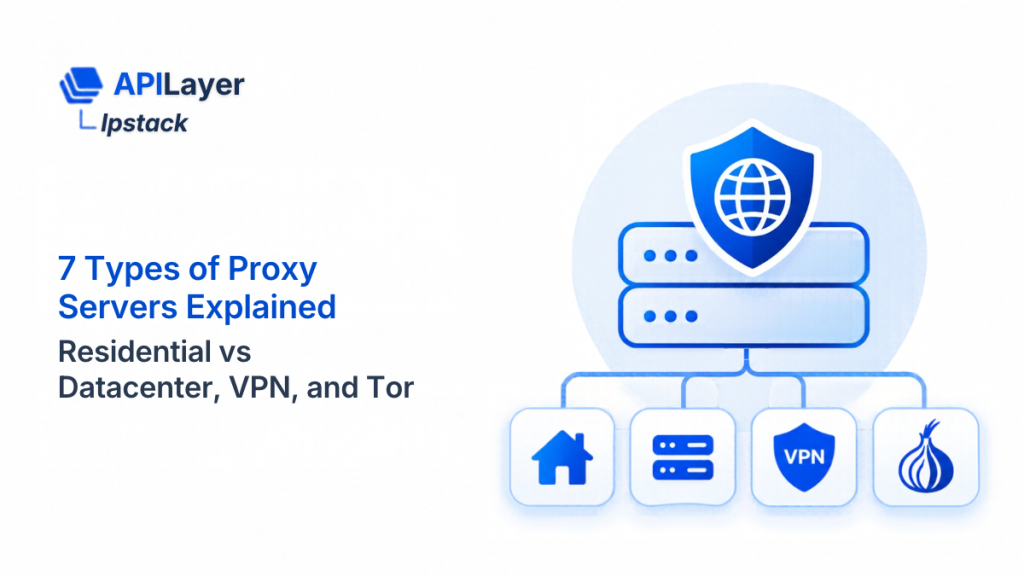
Table of Contents
What You Will Learn
- How ISPs assign residential IPs and what your default connection reveals online.
- Why people use proxies for privacy and why they create challenges for analytics.
- How IPstack and IP intelligence classify traffic as residential, mobile, VPN, Tor, or datacenter.
- Why not all proxies are for anonymity and how different proxy types serve technical purposes.
- How residential and datacenter IPs influence trust, risk scoring, and website behavior.
- How Tor’s multi-hop design affects anonymity and why it triggers stricter verification.
- How businesses use IP intelligence to secure access and support zero-trust systems.
How Your Internet Connection Identifies You Online
When you connect to the internet from home, you use a residential IP address automatically assigned by your Internet Service Provider (ISP). Most countries rely on a few major consumer ISPs such as Comcast, Spectrum, AT&T, Verizon, and Cox in the U.S.; BT, Deutsche Telekom, Orange, Vodafone, and Telefónica/O2 in Europe; and NTT, SoftBank, China Telecom, China Mobile, SK Telecom, KT, Jio, and Airtel across Asia. These companies operate large consumer networks built for everyday browsing, streaming, calls, and mobile use.
Your ISP can generally observe connection metadata, such as destination IP addresses, traffic volume, and connection timing. It may also identify websites through unencrypted DNS requests or other exposed connection information. However, HTTPS encrypts the contents of web communications, while encrypted DNS and other privacy protections can further limit what an ISP can observe.
Proxies as Both Shields and Traffic Controllers
Many people use proxies because their residential IP allocated to them by their ISP quietly functions like a visible “postcode.” It reveals where the connection originates, which can invite profiling, targeted messaging, or attention they never intended to attract. In unfamiliar environments online or offline broadcasting that information can feel intrusive. Using a proxy service is often simply the choice not to display that postcode everywhere you go.
From a personal point of view, proxies are a valuable layer of privacy, but from a business analytics perspective they’re a nightmare like trying to track customers while everyone insists on wearing identical Halloween masks, or imagine running a store where every customer walks in claiming their name is “Definitely Not A Bot.”
This is where IPstack comes in, helping companies make sense of the chaos by identifying whether a connection is residential, mobile, VPN, Tor, or datacenter-based even when the IP is wearing a metaphorical costume.
The internet relies on formal records of who owns each IP range. These records are managed by Regional Internet Registries (RIRs): ARIN, RIPE, APNIC, LACNIC, and AFRINIC. Their public databases often queried through WHOIS show which ISP or organization controls any given block of IP addresses.
IP intelligence companies such as IPstack expand on these public records by adding VPN server lists, Tor exit-node data, mobile carrier routing details, and behavioral analysis. This enables accurate classification of request origins, human user, corporate device, mobile network, or anonymizing relay making network-origin signals a key factor in real-time risk and authenticity scoring.

Why Not All Proxies Are Built for Anonymity
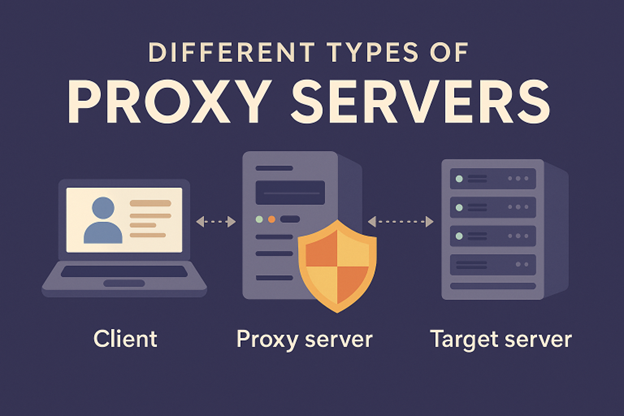
It’s important not to generalize the term proxy, because it doesn’t refer to a single purpose or a single type of tool. Some proxies exist to protect privacy, some exist to optimize traffic, and many exist simply to keep large systems running smoothly far from the stereotype of hiding or sneaking around online.
In this article, we will mainly focus on residential proxies and datacenter proxies, but it’s worth recognizing the broader ecosystem first:
- NGINX Reverse Proxy- Load Balancing -NGINX can act as a reverse proxy that distributes incoming traffic across multiple backend servers.
ideal when you need to balance load and hide your internal infrastructure from the public internet. - Squid Proxy- Web Caching-
frequently accessed web content to reduce bandwidth and speed up browsing. Companies use it to make internal network activity faster and more efficient for many users. - Cloudflare Reverse Proxy- Website Protection – Cloudflare sits between your website and the open internet to block attacks and filter malicious traffic. It’s used when you want automatic DDoS protection, bot mitigation, and global caching without managing hardware.
- Datacenter Proxy (Bright Data/Oxylabs)- Automated Testing-
They’re useful when you need to simulate users from different regions without exposing your real IP addresses. - Residential Proxy (Decodo/NetNut)- Local Search Verification- Residential
They’re used when verifying local ads, search results, or app behavior exactly as a real person would see it. - Tor Browser- Anonymous Research-
It’s used when researching sensitive topics where your identity or location needs strong protection. - HAProxy- High-Performance Load Balancing-
HAProxy is designed for large-scale, high-traffic systems and distributes requests across many backend servers. It’s used when businesses need zero-downtime deployments and reliable, fault-tolerant routing.
Proxy Type | Primary Use | Typical Users |
Residential Proxy | Local browsing simulation | Marketing teams, QA testing |
Datacenter Proxy | Automation and scraping | Developers, bots |
Reverse Proxy | Load balancing and security | Web infrastructure |
VPN | Privacy and encryption | Individuals, remote workers |
Tor | Maximum anonymity | Journalists, researchers |
Now, Let’s Look at the Two Proxy Types That Matter Most for Identity and Trust
While proxies can serve many different roles, residential and datacenter proxies are the ones most closely tied to how websites judge identity, authenticity, and risk. These two categories determine whether a connection looks like it’s coming from a real household user or from a server, relay, or automation system and that distinction shapes how nearly every modern website responds to incoming traffic.
How IP Classification Becomes a Trust Signal
Websites can instantly recognize residential network space, whether it comes from a major national ISP or a small local provider. A residential IP suggests a real person in a stable location and naturally carries more trust than traffic coming from datacenters or proxy infrastructure.
When you browse from your home Wi-Fi without a VPN, your traffic travels directly through your ISP and presents an approximate household location usually narrowed to a city or postcode. Nothing is masked or rerouted, and this default signal looks like normal human behavior. That’s why websites rely on residential IPs to personalize content, validate identity, and detect unusual activity.
Datacenter IPs tell a very different story. They come from cloud environments like AWS, Google Cloud, Azure, and DigitalOcean networks built for hosting apps, not casual browsing. So when a website sees a datacenter IP, it often assumes automation, scraping, or a relay service. Even legitimate traffic starts at a lower trust level because it doesn’t resemble a typical household user.
How Residential vs. Datacenter IPs Shape Risk Scoring
Modern risk systems begin with a simple distinction:
Residential IPs look like real users; datacenter IPs look like infrastructure.
Proxy networks sit between these two categories, routing traffic through datacenters (fast, cheap, easily flagged) or through residential networks (slower, more expensive, harder to detect). Understanding proxy detection starts with understanding what “normal” traffic looks like: when you browse from home, the internet sees you; when you use a proxy or VPN, it sees the service acting in your place.
Tor: The Anonymity Network
Tor works differently from standard proxies or VPNs. Instead of one server, it routes your traffic through several volunteer-operated relays, with each hop only knowing the one before and after it. This layered design creates strong anonymity no single node knows both who you are and where you’re going.
Tor prioritizes privacy over speed and is used by journalists, activists, researchers, and people avoiding surveillance. But because Tor exit nodes are public and shared by many users, websites treat Tor cautiously: banks often block it, e-commerce sites use CAPTCHAs, and some services disable account creation from Tor IPs. The principle is simple: the more a connection hides identity, the more carefully a website evaluates trust.
Why Residential IPs Are Trusted and Datacenter IPs Are Not
Websites treat these IP types differently because they represent different real-world behavior.
be so streaming platforms show the correct regional content, and banks see your login as normal. But if the same account appears from a datacenter IP or a distant location, banks may trigger extra verification because those patterns often resemble fraud.
E-commerce systems do the same. Home users check out smoothly; datacenter IPs from AWS or DigitalOcean often trigger CAPTCHAs because scalper bots rely heavily on those ranges. Social platforms push extra verification on proxy-based signups because fake accounts frequently originate from rotating proxy pools.
Across all these examples, the logic is consistent: Residential IP addresses are commonly associated with consumer networks, while datacenter IPs are associated with cloud and hosting infrastructure. Neither classification alone establishes whether a request is legitimate or automated. Businesses should evaluate IP origin alongside authentication events, request behavior, reputation signals, and other security contexts.
Websites adjust trust, verification steps, and access rules accordingly. This isn’t about judging individuals; it’s statistical risk management.
Even criminals tend to prefer datacenter IPs because they’re cheap, scalable, and disposable. But those same cloud providers also maintain logs, billing records, and account trails that investigators can follow, which is why IP origin remains a crucial part of digital forensics.
Why This Matters for Businesses (and Where IPstack Fits In)
For organizations, verifying who is accessing a system is only part of secure authentication. Verifying how and from where they are connecting is just as important. Even strong passwords or multi-factor authentication cannot prevent account sharing or unauthorized access if the authentication originates from an untrusted network.
By using IP intelligence to understand whether a request originates from a residential network, a corporate network, a mobile carrier, a VPN, a Tor exit node, or a datacenter proxy, a business can quickly determine whether access is happening through the intended, secure pathways. If an employee logs in from the company VPN or approved office network, the activity is considered normal. If the same account suddenly appears from a commercial proxy service or unknown datacenter IP, the system has a strong signal that additional verification is needed.
This is where IPstack provides value. IPstack provides connection metadata such as ISP and ASN information, alongside security signals on eligible plans. Its Security Module can return proxy indicators, Tor detection, VPN-service information, hosting-facility signals, and threat classifications when requested with security=1. These indicators help applications evaluate network risk, but do not independently verify a user’s identity. The Security Module is available on the Professional Plus plan.
In modern zero-trust security models, the network origin is part of the identity. IPstack helps make that signal visible and actionable.
FAQs
How does a website know if someone is using a proxy or VPN?
type of residential, datacenter, mobile carrier, corporate network, Tor exit node, or commercial VPN endpoint. If an IP is associated with hosting providers, proxy infrastructure, or known relay endpoints, the website may apply additional verification or restrictions.
Why do businesses care where a connection originates?
IP type is one of the strongest real-time indicators of user authenticity. Residential IPs generally represent real individuals in stable locations. Datacenter and proxy IPs are more likely to represent relays, automation tools, or identity masking. Businesses use IP origin to detect fraud, enforce access controls, and improve analytics accuracy.
How does IPstack detect proxies, VPNs, and Tor traffic?
IPstack analyzes the ownership, routing, and behavior patterns of each IP address. It identifies whether the IP originates from cloud hosting providers, VPN services, Tor exit nodes, mobile carriers, or residential networks. This allows platforms to score traffic trust and apply appropriate security policies.
What are the main types of proxy servers?
The main types of proxy servers are: Residential, datacenter, reverse proxies, web caching proxies, VPN proxies, and Tor nodes.