


Table of Contents
Key Takeaways
- AI agents represent the fastest growing user segment, yet only 24% of developers design APIs specifically for them despite high general AI usage.
- Agents require machine-readable definitions and literal patterns, so structured documentation and consistent schemas are mandatory for reliable performance.
- Use programmatic authentication like API keys or tokens because agents cannot handle manual or multi-step human login processes.
- Consistent JSON structures and typed errors reduce hallucinations while dynamic rate limiting supports high-frequency agent access patterns.
- Security models must shift to agent-aware monitoring and least-privilege access to handle the speed and scale of automated calls.
- APILayer tools like IPstack and Marketstack provide the structured responses and clean documentation needed to build agentic workflows immediately.
Introduction
APIs used to be straightforward. You built endpoints, shipped docs, and developers integrated your service. That model worked for decades. But now we are entering in 2026. AI agents are consuming APIs at scale, and they don’t behave like human developers.
Postman’s 2025 State of the API Report reveals a striking disconnect: 89% of developers use AI tools daily, yet only 24% design APIs with AI agents in mind. Meanwhile, agents have become the fastest-growing API consumer segment.
The gap creates real problems. Unlike humans who interpret vague docs and adapt to inconsistent patterns, agents need machine-readable schemas, predictable responses, and explicit error handling. They can’t infer intent or work around ambiguity.
OpenAI, Google, and Microsoft are building agents that call APIs thousands of times per second and execute autonomous decisions. Finance, healthcare, and SaaS companies are moving fast to keep up. Your API has evolved from a simple connector into a cognitive interface for intelligent systems.
Now the question: how quickly can you make your APIs agent-ready?
Building for agents gives you an advantage in the agentic economy. Agents connect faster to APIs designed for machine logic and reasoning. You also get less friction because clear schemas mean fewer bugs for both humans and machines. This leads to faster onboarding and better results for your team.
Agent-ready APIs fix technical hurdles regardless of which protocol becomes the standard. This guide walks you through making your APIs agent-ready with practical implementation strategies and real examples using APILayer’s production APIs.
What is an API?
An API (Application Programming Interface) is a set of rules and protocols that allows different software applications to communicate and share data with each other. Think of it as a contract between two systems that defines how they can talk and what information they can exchange.
Key API Characteristics:
- Request-Response Protocol: Client sends a request to a specific endpoint, and the server processes it and returns data in a structured format.
- Standardized Endpoints: Each URL path handles a specific action or resource, like /users for user data or /orders for order information.
- Data Format: APIs typically return data as JSON, XML, or protocol buffers, making it easy for applications to parse and use the response.
- Authentication: API keys, OAuth tokens, or other credentials control who can access your API and what actions they can perform.
- Rate Limiting: Throttling mechanisms protect servers from overuse by limiting how many requests a client can make within a specific time window.
What is an AI Agent?
An AI agent is an autonomous or semi-autonomous software system powered by large language models (LLMs) or other AI technologies that operates with minimal human oversight. These agents can reason, plan, and use tools like software, APIs, and external systems to achieve complex, multi-step goals.
An AI agent can:
- Understand context from user requests and environmental data to determine intent.
- Make decisions about which actions to take based on available information and goals.
- Plan multi-step workflows to achieve complex objectives without predefined scripts.
- Call tools and APIs to execute tasks autonomously, from retrieving data to triggering actions.
- Learn from outcomes and adapt behavior to improve performance over time.
Why AI Agents Are Becoming Primary API Users
- More efficient than traditional integrations: Agents adapt to API changes without code rewrites, eliminating the need for 1-to-1 integrations that human developers typically build.
- Enables scale without proportional cost: One agent can work with any API that has clear documentation, reducing integration burden from linear to logarithmic growth.
- Unlocks autonomous business processes: Agents manage inventory, route healthcare data, handle customer onboarding, all without human intervention.
- Agents become new revenue channel: Organizations with agent-ready APIs integrate faster and capture market share, creating first-mover advantage in the agent economy
The Competitive Threat: Organizations building “human-first” APIs risk becoming bottlenecks in this shift. Agents will fail silently, hallucinate solutions, or miss opportunities when APIs lack machine-readable schemas and predictable patterns. Agent-ready APIs deliver faster feature releases, lower integration costs, higher customer satisfaction, and direct access to the growing agent economy.
Make Your APIs Agent-Ready in 2026

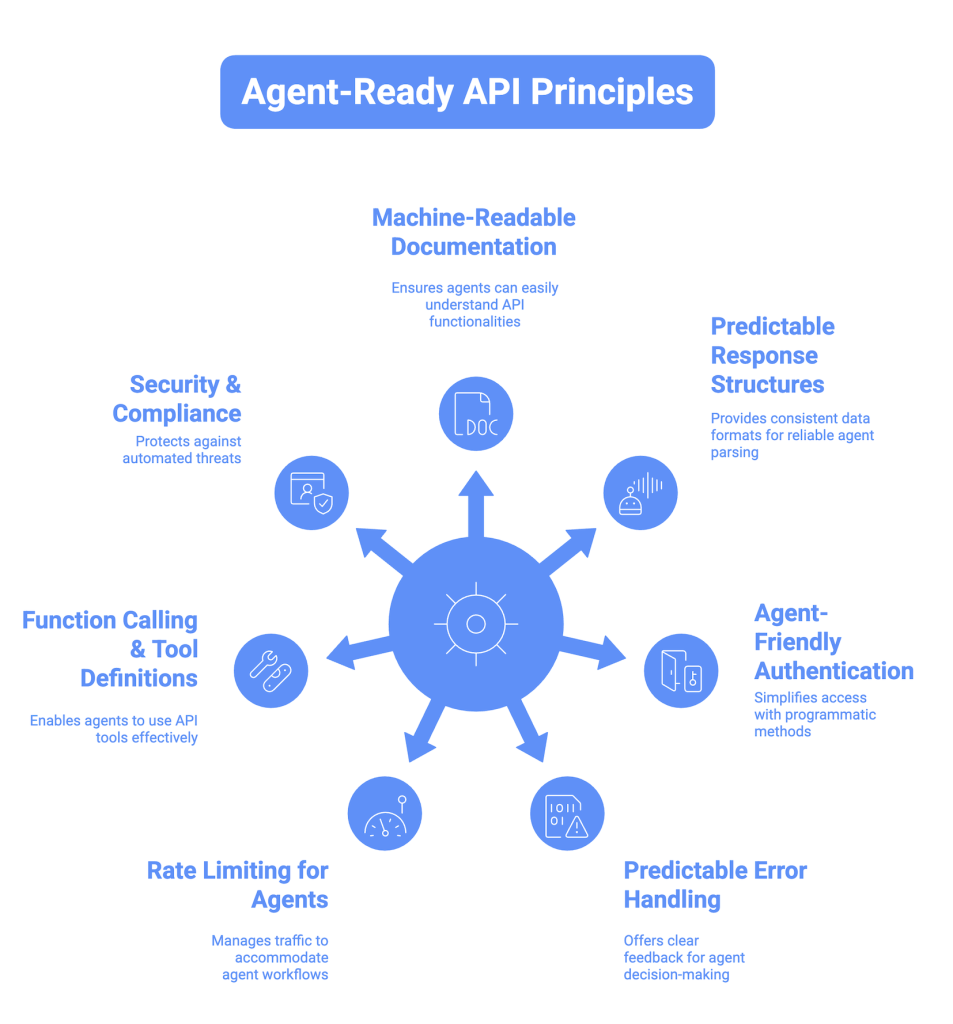
Principle 1: Machine-Readable Documentation (Example: OpenAPI 3.0+)
Agents discover what your API can do by reading your OpenAPI specification, a machine-readable schema that describes every endpoint, parameter, and response format. Unlike human developers who can infer missing details or read between the lines, AI agents rely entirely on what you document.
What This Means:
Your OpenAPI spec should be:
- Complete: Every endpoint, parameter, and response is documented with explicit data types and constraints.
- Exposed: Available at a standard endpoint like /.well-known/openapi.json or /openapi.json for automatic discovery.
- Correct: Examples actually work in real-world scenarios; parameters match reality, not outdated documentation.
- Typed: Every field has a data type (string, number, boolean, object, array) so agents know what to expect.
- Contextual: Descriptions use clear, non-technical language that helps agents understand intent and usage patterns.
Why Agents Need This:
- Discovery: Agent reads OpenAPI spec to understand what tools are available without hardcoding rules.
- Validation: Agent checks required parameters before making a call, reducing failed requests and wasted tokens.
- Error Handling: Agent knows which status codes to expect and what they mean for decision-making.
- Automatic Retry Logic: Agent can extract Retry-After headers without hardcoding logic into each integration
Principle 2: Predictable, Consistent Response Structures
Agents rely on patterns. If your API sometimes returns data one way and sometimes another, agents break or hallucinate solutions to fill gaps. Human developers can adapt to inconsistencies, but agents need deterministic behavior to function reliably.
The Golden Rule: Flatten Your Schema
Deeply nested JSON structures confuse agents.
Avoid this:
					{
  "user": {
    "profile": {
      "personal": {
        "name": "Jay",
        "email": "jay@example.com"
      }
    }
  }
}
Prefer this:
					{
  "id": "user_123",
  "name": "Jay",
  "email": "jay@example.com",
  "created_at": "2025-01-01T10:00:00Z"
}
Standard Response
All responses should follow a consistent structure of success or failure:
					{
  "success": true,
  "data": {...},
  "metadata": {
    "timestamp": "2025-12-21T21:03:00Z",
    "request_id": "req_abc123"
  }
}
Error Response (Same Structure!)
Lorem ipsum dolor sit amet, consectetur adipiscing elit. Ut elit tellus, luctus nec ullamcorper mattis, pulvinar dapibus leo.
					{
  "success": false,
  "data": null,
  "error": {
    "code": "INVALID_PARAMETER",
    "message": "The 'email' parameter must be a valid email address.",
    "details": {
      "parameter": "email",
      "provided_value": "not_an_email",
      "expected_format": "user@domain.com"
    }
  }
}
Why This Matters for Agents:
- Predictable parsing: Agent always knows where to find success or failure data without conditional logic for edge cases.
- Consistent error handling: Same code path for all error types reduces complexity and improves reliability.
- Reduced hallucination: Agent doesn’t have to guess at response structure or invent fields that might exist.
- Better observability: Request IDs and structured error codes enable better tracing and debugging when things go wrong.
Principle 3: Agent-Friendly Authentication
Agents can’t click “Login with Google” or fill out multi-step forms. They need programmatic, documented, and predictable auth methods that work without browser redirects or manual intervention.
Recommended Authentication Methods for Agents:
Method | Best For | Example |
API Keys | Service-to-service, automated workflows | Authorization: Bearer sk_live_abc123xyz |
OAuth 2.0 (Client Credentials) | Apps that need user permissions without user interaction | Grant type: client_credentials |
JWT Tokens | Stateless auth with short expiration | Token issued with 1-hour TTL, automatic refresh |
Mutual TLS | Enterprise security, agent-to-agent communication | Client certificate validation |
What NOT to Use:
- Multi-factor authentication flows: Unless automated via backup codes, these require human interaction.
- Browser-based login: Google/GitHub OAuth with redirects breaks agent workflows that don’t render web pages.
- Session cookies: Agents aren’t browsers and can’t maintain stateful sessions reliably.
- Rotating passwords: Too manual for agents operating at machine speed without human oversight.
Agent Authentication Best Practices:
- Keep it simple: API keys or OAuth client credentials flow provide programmatic access without user interaction.
- Document the auth flow: Include example auth headers in docs so agents understand exactly how to authenticate.
- Support agent identification: Let agents pass X-Agent-ID headers for tracking and behavioral analysis.
- Rotate credentials safely: Provide programmatic credential rotation endpoints, not just manual dashboard controls.
Principle 4: Predictable Error Handling & Status Codes
Agents need clear feedback when something goes wrong. Vague error messages lead to silent failures or hallucinated workarounds where agents invent solutions that don’t exist. Consistent error structures help agents decide whether to retry, fall back, or escalate to human operators.
Typed Error Responses
{
"success": false,
"data": null,
"error": {
"code": "INVALID_PHONE_NUMBER",
"type": "validation_error",
"message": "The phone number provided is not valid for the country specified.",
"severity": "error",
"details": {
"field": "phone_number",
"provided": "+1 (555) 123-FAKE",
"reason": "Invalid format for country code US",
"suggested_fix": "Use format +1 (555) 123-4567"
},
"documentation_url": "https://api.example.com/docs/phone-validation"
}
}
Start Building with APILayer
Access a powerful ecosystem of APIs for IP intelligence, finance, search, geolocation, validation, and more. Build faster with reliable APIs trusted by developers worldwide.
Explore APILayer APIsDeveloper-friendly documentation
Error Codes Dictionary (Example)
Publish a reference of all possible error codes your API can return:
PRODUCT_NOT_FOUND (404) Principle 5: Rate Limiting Designed for AgentsTraditional rate limiting (like “1000 requests per minute per API key”) works for humans making occasional calls. Agents operate differently, making thousands of coordinated requests in seconds as part of normal workflows. Agents need smarter rate limiting that accounts for:
Recommended Rate Limiting Strategy for Agents:
Principle 6: Function Calling & Tool DefinitionsIf your API is consumed by LLM-powered agents, you need to define how agents should call your tools. Function definitions tell agents what your API can do in a format they understand natively. OpenAI Function Calling Format Agents orchestrated by OpenAI’s platform use a specific function calling syntax. When your API exposes tool definitions, agents automatically understand what’s available without parsing human documentation. Agents understand:
Example tool definition for a product inventory check: |
					{
  "type": "function",
  "function": {
    "name": "get_product_inventory",
    "description": "Check real-time inventory for a specific product. Essential for agents verifying stock before confirming orders.",
    "parameters": {
      "type": "object",
      "properties": {
        "product_id": {
          "type": "string",
          "description": "Unique product identifier (e.g., SKU or UUID)"
        },
        "warehouse_id": {
          "type": "string",
          "description": "Optional: Specific warehouse to query. If omitted, returns total inventory."
        }
      },
      "required": ["product_id"]
    }
  }
}
The agent workflow works like this: User request – Agent reads function definitions – Agent decides which function to call – Agent constructs parameters – API executes – Agent receives response and continues. Each function call returns a stringified JSON object that the agent parses and uses to determine next steps.
Principle 7: Security & Compliance for Agent Access
Agents operate at machine speed and scale, making thousands of decisions per minute without human oversight. Traditional security models built for human API consumers don’t account for this velocity and autonomy.
New Security Threats from Agents:
Threat | Example | Prevention |
Machine-speed exploitation | Attacker agents probe 10,000 vulnerabilities/second | Rate limiting + behavioral analysis |
Credential amplification | One compromised API key → access to multiple systems | Least privilege + API key scoping |
Persistent automated attacks | Agents attack indefinitely, unlike humans | Monitoring + anomaly detection |
Behavioral unpredictability | Agents access APIs in unusual patterns | Whitelist legitimate patterns; alert on deviations |
AI Agent-Ready APIs with APILayer
APILayer’s product suite is designed with agent-readiness at its core. Each API features comprehensive documentation, predictable responses, and reliable uptime, making them ideal building blocks for agentic workflows.
IPstack: Real-Time IP Geolocation

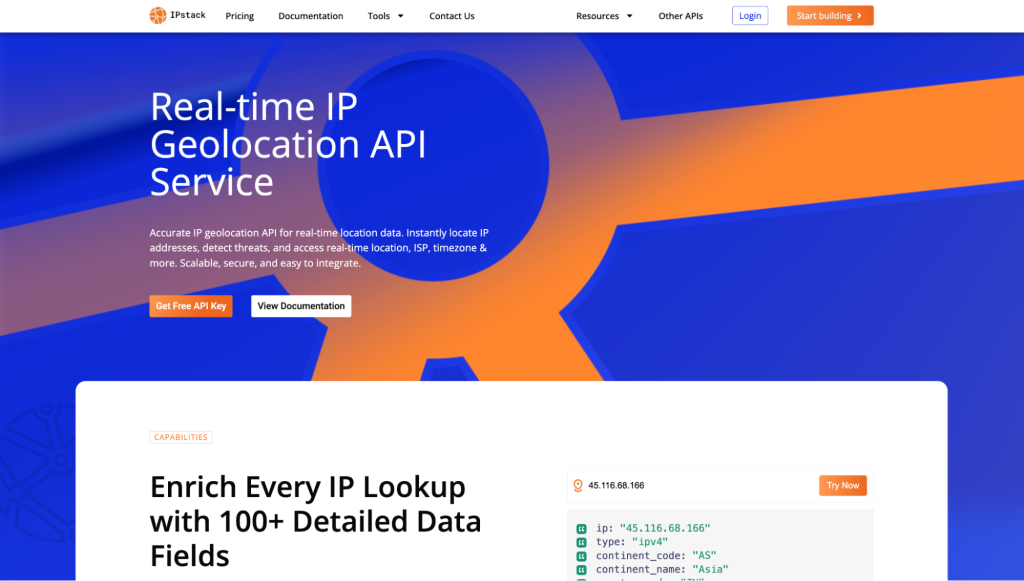
IPstack converts IP addresses into actionable geographic and ISP data, delivering results within milliseconds in JSON or XML format. The API looks up accurate location data and assesses security threats originating from risky IP addresses, allowing agents to make location-based decisions without human intervention.
Agent-Ready Features:
- Predictable response structure: Every response follows the same schema with consistent field names for ip, type, continent_code, country_name, city, and other location attributes.
- Comprehensive optional fields: Include only what you need using field parameters, reducing payload size and parsing time for agents.
- Bulk query support: Process up to 50 IPs in a single call by separating addresses with commas, perfect for batch operations.
- Clear error codes: Invalid IPs return code 404, auth failures return 101, and rate limits return 104 with explicit error messages.
- HTTPS/SSL encryption standard: All plans support 256-bit SSL encryption for secure agent-to-API communication.
API Implementation
					import requests

def get_ip_location(ip_address, api_key):
    """Get geographic and ISP data for an IP address."""
    response = requests.get(
        f"https://api.ipstack.com/{ip_address}",
        params={'access_key': api_key}
    )
    data = response.json()

    if data.get('type') == 'error':
        return {'error': data['error']['info']}

    return {
        'country': data.get('country_name'),
        'city': data.get('city'),
        'isp': data.get('isp'),
        'is_proxy': data.get('security', {}).get('is_proxy'),
        'is_crawler': data.get('security', {}).get('is_crawler')
    }

# Usage: location_data = get_ip_location('72.229.28.185', api_key)
Agent Use Cases:
Fraud detection: Validate login location against user history to flag suspicious access patterns automatically.
Content delivery: Serve localized content, pricing, and language preferences based on detected geography.
Compliance: Check IPs against sanctioned countries and restrict access based on regional legal requirements.
Personalization: Customize language, currency, and offers using location data to improve conversion rates.
Lead scoring: Enrich leads with geographic context including timezone, ISP, and connection type for better qualification.
Marketstack: Real-Time Financial Data

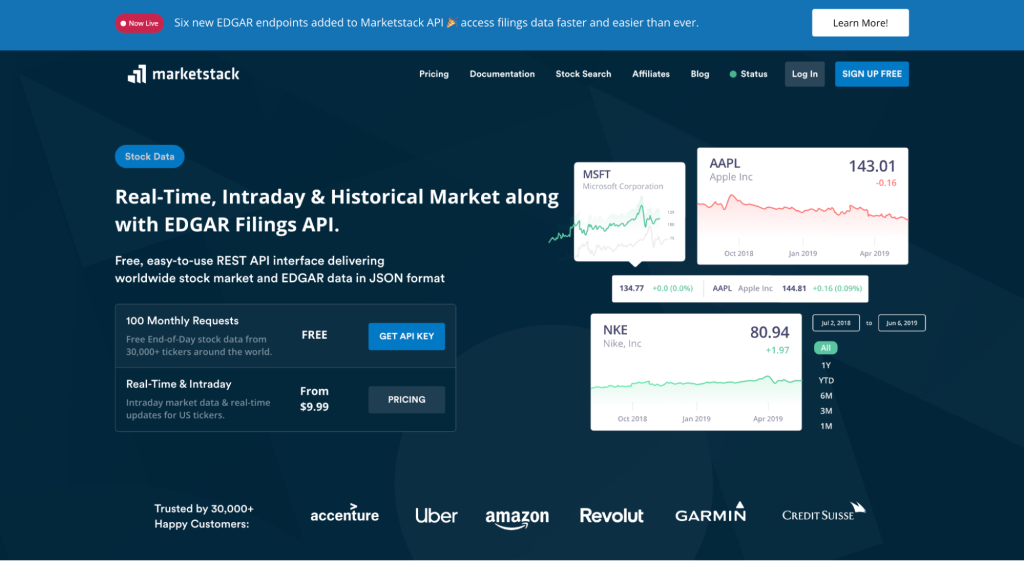
Marketstack delivers real-time and historical stock market data for 170,000+ tickers across 70+ global exchanges, including NASDAQ, NYSE, and international markets. The API provides intraday data with intervals as short as one minute, end-of-day prices, and up to 30 years of historical data in a simple JSON format.
Agent-Ready Features:
Multiple endpoints: /intraday, /eod, and /timeseries endpoints serve different time horizons, from minute-by-minute updates to yearly aggregates.
Flexible data selection: Request only the fields you need using parameter filters to reduce payload size and processing time.
Bulk ticker support: Query multiple stock symbols in one call by separating them with commas, perfect for portfolio monitoring.
Consistent pagination: Navigate large datasets predictably using limit and offset parameters with default 100 results per page, max 1000.
Clear error handling: Agents know exactly how to handle failures with explicit error codes and messages in every response.
API Implementation
					import requests

def get_stock_quotes(symbols, api_key):
    """Fetch latest quotes for multiple stock symbols."""
    response = requests.get(
        'https://api.marketstack.com/v2/intraday',
        params={
            'symbols': ','.join(symbols),
            'access_key': api_key,
            'limit': 100
        }
    )
    data = response.json()

    if not data.get('data'):
        return {'error': 'No data found'}

    quotes = []
    for quote in data['data']:
        quotes.append({
            'symbol': quote['symbol'],
            'price': quote['last'],
            'change_percent': quote['change_pct'],
            'volume': quote['volume']
        })

    return {'quotes': quotes}

# Usage: quotes = get_stock_quotes(['AAPL', 'MSFT', 'TSLA'], api_key)
Agent Use Cases:
- Portfolio monitoring: Alert users automatically when stocks drop more than 10% using continuous intraday data streams.
- Earnings alerts: Flag high-volatility stocks around earnings dates by detecting unusual volume and price movements.
- Arbitrage detection: Identify price discrepancies across different exchanges by comparing real-time data from multiple markets.
- Technical analysis: Calculate moving averages, RSI, and other indicators using historical data to generate buy/sell signals.
- Risk assessment: Detect correlation breakdowns between assets and trigger automatic portfolio rebalancing.
Weatherstack: Real-Time Weather Data


Weatherstack provides current weather, historical data, and 14-day forecasts for millions of locations globally through a simple REST API. The API is powered by data from major weather stations worldwide and handles everything from a few hundred requests monthly to millions per minute on the apilayer cloud infrastructure.
Agent-Ready Features:
- Multiple query methods: Query by city name, latitude/longitude coordinates, IP address, postal code, or use fetch:ip to auto-detect requester location.
- Current, historical, and forecast endpoints: One API for all temporal queries, from multi-year history to 14-day forecasts with hour-by-hour data.
- Consistent data structure: Same JSON fields in every response including temperature, wind speed, humidity, pressure, and location details.
- Bulk queries: Request weather for 10+ locations in one call by separating locations with semicolons, reducing API calls significantly.
- Language localization: Weather descriptions available in 30+ languages for global applications.
API Implementation
Lorem ipsum dolor sit amet, consectetur adipiscing elit. Ut elit tellus, luctus nec ullamcorper mattis, pulvinar dapibus leo.
					import requests

def get_weather_and_alerts(location, api_key):
    """Get current weather and generate agent-actionable alerts."""
    response = requests.get(
        'https://api.weatherstack.com/current',
        params={
            'access_key': api_key,
            'query': location,
            'units': 'm'
        }
    )
    data = response.json()

    if not data.get('success'):
        return {'error': data['error']['info']}

    current = data['current']
    alerts = []

    if current['temperature'] > 35:
        alerts.append('EXTREME_HEAT')
    if current['precip'] > 10:
        alerts.append('HEAVY_RAIN')
    if current['wind_speed'] > 50:
        alerts.append('HIGH_WINDS')

    return {
        'temperature': current['temperature'],
        'condition': current['weather_descriptions'],
        'alerts': alerts
    }

# Usage: weather = get_weather_and_alerts('London', api_key)
Agent Use Cases:
- Supply chain optimization: Monitor warehouse weather conditions and automatically reroute shipments around severe weather events.
- Event planning: Check 14-day forecasts and suggest indoor venue alternatives if severe weather is predicted.
- Delivery routing: Avoid flooded areas and adjust delivery schedules based on real-time precipitation and road condition data.
- Agriculture: Trigger automated irrigation systems or send frost risk warnings to farmers based on temperature forecasts.
- Customer service: Offer weather-relevant products proactively, like umbrellas before rain or AC units during heat waves.
Numverify: Phone Number Validation
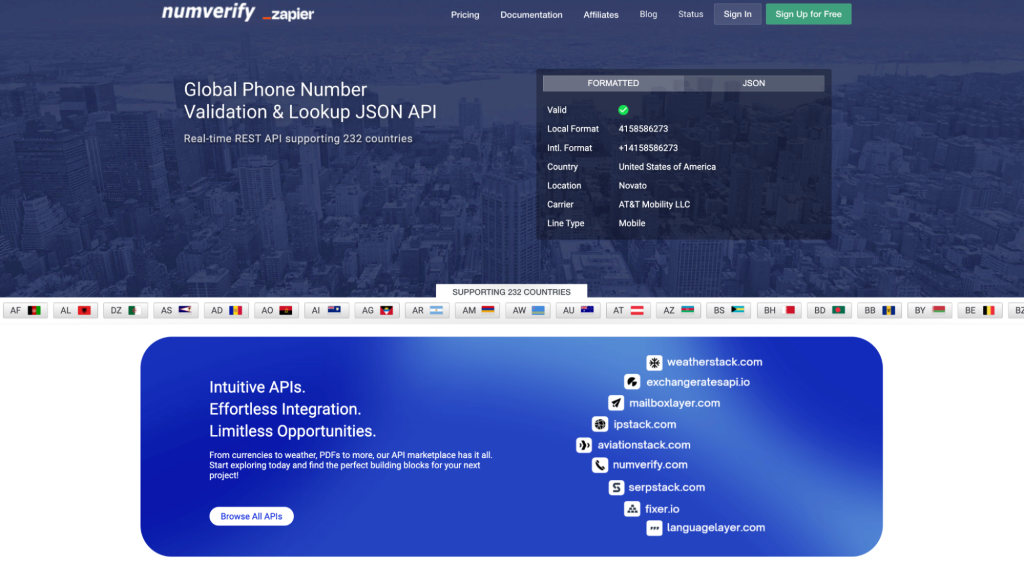
Numverify validates phone numbers across 232 countries in real-time, returning format verification, carrier info, line type (mobile/landline/VoIP), and fraud risk indicators. The API processes numbers in real-time by cross-checking against the latest international numbering plan databases and returns clean JSON responses enriched with carrier, geographical location, and line type data.
Agent-Ready Features:
- Real-time validation against IANA databases: Numbers are cross-referenced against perpetually updated international numbering plans to ensure accuracy.
- Carrier and line type detection: Identifies mobile vs. landline vs. VoIP numbers and returns the telecommunications provider associated with each number.
- Location inference: Returns geographic region, country code, and location data directly from the phone number structure.
- Fraud risk indicators: Flags VoIP numbers often used to hide identity and detects carrier mismatches that indicate spoofing risks.
- Bulk validation support: Validate multiple numbers in a single call by accessing data from 1,500+ global telecom providers at once.
API Implementation
					import requests

def validate_phone_for_lead(phone, country_code, api_key):
    """Validate phone and assess fraud risk for lead qualification."""
    response = requests.get(
        'http://apilayer.net/api/validate',
        params={
            'access_key': api_key,
            'number': phone,
            'country_code': country_code
        }
    )
    data = response.json()

    if not data.get('valid'):
        return {'valid': False, 'action': 'REJECT'}

    fraud_risk = 0
    if data.get('line_type') == 'voip':
        fraud_risk += 0.5
    if data.get('line_type') == 'mobile':
        fraud_risk -= 0.2  # Mobile is lower risk

    return {
        'valid': True,
        'carrier': data.get('carrier'),
        'line_type': data.get('line_type'),
        'fraud_risk': fraud_risk,
        'action': 'REQUIRE_VERIFICATION' if fraud_risk > 0.3 else 'ACCEPT'
    }

# Usage: result = validate_phone_for_lead('+1 415 858 6273', 'US', api_key)
Agent Use Cases:
- Lead scoring: Validate phone format, check carrier quality, and automatically adjust lead quality scores based on line type.
- Customer onboarding: Verify format correctness, confirm number is SMS capable (not landline), and trigger OTP workflows safely.
- Fraud prevention: Flag VoIP and prepaid numbers that suggest higher fraud risk, then request additional verification steps.
- SMS marketing: Validate numbers before launching campaigns and filter out high-risk numbers to protect sender reputation.
- Customer support: Verify phone authenticity and route to SMS or call channels based on detected line type.
Conclusion
AI agents are fundamentally changing how APIs are consumed. The shift from human-first to agent-first design isn’t optional anymore; it’s strategic positioning. Organizations that make their APIs agent-ready today gain competitive advantage through faster integrations, lower costs, and direct access to the growing agent economy. The 7 principles in this guide provide a complete roadmap. Start by auditing your most critical API, implementing machine-readable documentation and consistent response structures, then iterate based on real agent behavior.
APILayer’s production-grade APIs like IPstack, Marketstack, Weatherstack, and Numverify are already agent-ready with predictable schemas and comprehensive documentation. Start building your agentic workflows today with APILayer. See how agent-ready APIs accelerate your integration timeline.
FAQs
What’s the main difference between a regular API and an agent-ready API?
Agent-ready APIs provide machine-readable documentation (OpenAPI specs), consistent JSON structures, and explicit error codes, while traditional APIs often rely on human developers to interpret vague docs and adapt to inconsistent patterns.
Can AI agents handle OAuth flows with multi-step authentication?
No, agents cannot complete browser-based OAuth flows or multi-factor authentication that requires human interaction, so you need programmatic auth methods like API keys, client credentials, or JWT tokens.
Do I need to rewrite my entire API to make it agent-ready?
Not necessarily. Start by exposing an OpenAPI spec at a standard endpoint, flatten your response structures, and ensure error codes are typed and consistent across all endpoints.
How do agents know which API endpoint to call?
Agents read your OpenAPI specification or function definitions to understand available endpoints, required parameters, and expected responses, then use this metadata to construct valid requests automatically.
What happens if my API returns inconsistent response formats?
Agents will either fail silently, hallucinate missing fields to fill gaps, or make incorrect decisions based on malformed data, leading to unreliable behavior in production workflows.
Why should I use APILayer APIs for building AI agents?
APILayer’s products (IPstack, Marketstack, Weatherstack, Numverify) ship with complete OpenAPI specs, flat JSON schemas, and consistent error handling out of the box, eliminating the integration overhead of making third-party APIs agent-compatible.