


APIs power almost every modern digital experience. They help organisations automate workflows, personalise content, secure transactions, and integrate with external systems. As businesses grow, the number of APIs they rely on grows as well. This leads to a familiar problem: too many vendors, too many authentication flows, and too many inconsistent data formats across services.This is where API aggregation becomes a powerful architectural approach. By providing a unified API interface backed by multiple data sources, teams can significantly simplify their application logic, accelerate development, and reduce integration overhead.
This guide explains what API aggregation is, why it matters, and how developers, SMBs, and enterprises can implement it effectively. To keep things practical, we use the APILayer ecosystem as a concrete reference for building real-world aggregation layers.
Table of Contents
Key Takeaways
- API aggregation combines multiple APIs behind a single interface to simplify integration, reduce complexity, and improve developer experience
- Teams adopt aggregation to reduce vendor integrations, unify authentication, ensure consistent data, and streamline client-side logic
- APILayer offers a practical provider-level approach where developers can build their own internal aggregation layer using reliable APIs for IP intelligence, geolocation, email validation, currency data, scraping, and more
- API aggregation is not always necessary; it provides value when systems depend on multiple data sources, when standardisation is required, or when performance and governance need improvement
- Implementing an aggregation strategy requires clarity about architecture patterns, tradeoffs, and operational impact
What Is API Aggregation?
API aggregation is the practice of combining multiple APIs behind a single interface that clients interact with. Instead of calling several vendors one by one, the client calls your unified API. Your backend then orchestrates requests, merges or transforms responses, and returns a single output.

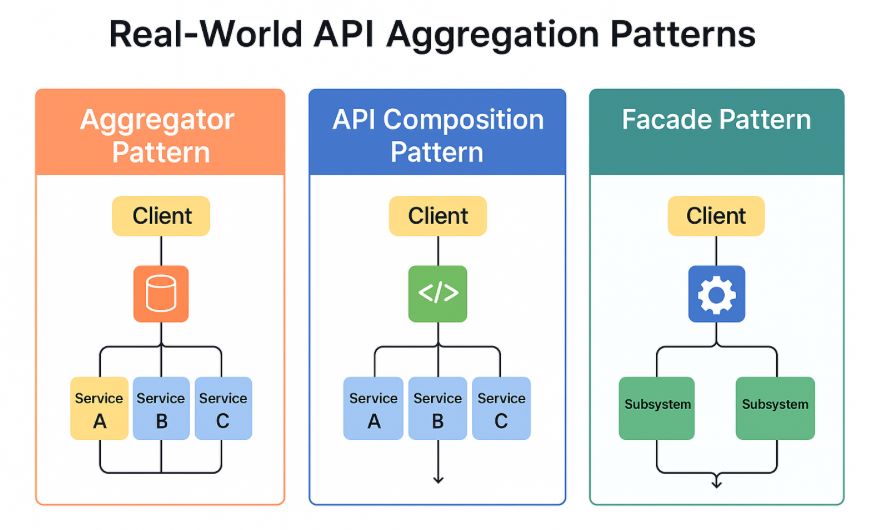
At its core, aggregation solves three central challenges:
- Too many integrations
- Too much inconsistent data
- Too much client-side complexity
When implemented well, API aggregation acts as a stable contract for your application, shielding your frontend and mobile clients from changes in vendor APIs or new third-party services you might integrate later.
Why Teams Adopt an API Aggregation Strategy
Aggregation is increasingly common across engineering teams for several practical reasons:
1. Simpler Integrations
Calling one API is always simpler than calling five. Aggregation removes unnecessary work on the client, reduces error-handling complexity, and creates a predictable structure for future integrations.
2. Unified Authentication
Different APIs require different types of authentication. An aggregation layer allows teams to:
- store vendor credentials securely
- centralise access control
- expose a single authentication model to internal teams
This avoids leaking keys into client-side applications.
3. Cleaner Client Code
Frontend developers no longer need to manage multiple fetches, handle inconsistent schemas, or combine data manually. A single endpoint returns exactly what each interface needs.
4. Better Performance
When aggregation is implemented server-side, it enables:
- batching
- caching
- parallelisation
- response normalisation
This leads to faster response times and reduced bandwidth usage.
5. Reduced Vendor Lock-In
If your application is tied directly to multiple external APIs, replacing a vendor becomes expensive. Aggregation helps you insulate your architecture, making swapping providers easier.
APILayer as an Aggregation Foundation
APILayer provides more than twenty production-ready APIs used across industries. This ecosystem enables teams to build an internal aggregation layer using a consistent structure, documentation style, and authentication model.
Some of the most useful API categories for aggregation include:
- IP data and geolocation
- Currency and exchange data
- Email validation
- Phone validation
- Scraping APIs and SERP data
- User agent parsing
- Fraud detection
- Business verification
- Weather data
Because APILayer standardises uptime expectations, response structures, and pricing, developers gain a predictable base for building internal unified APIs.
Example: Creating an Internal “User Intelligence” Aggregation Layer

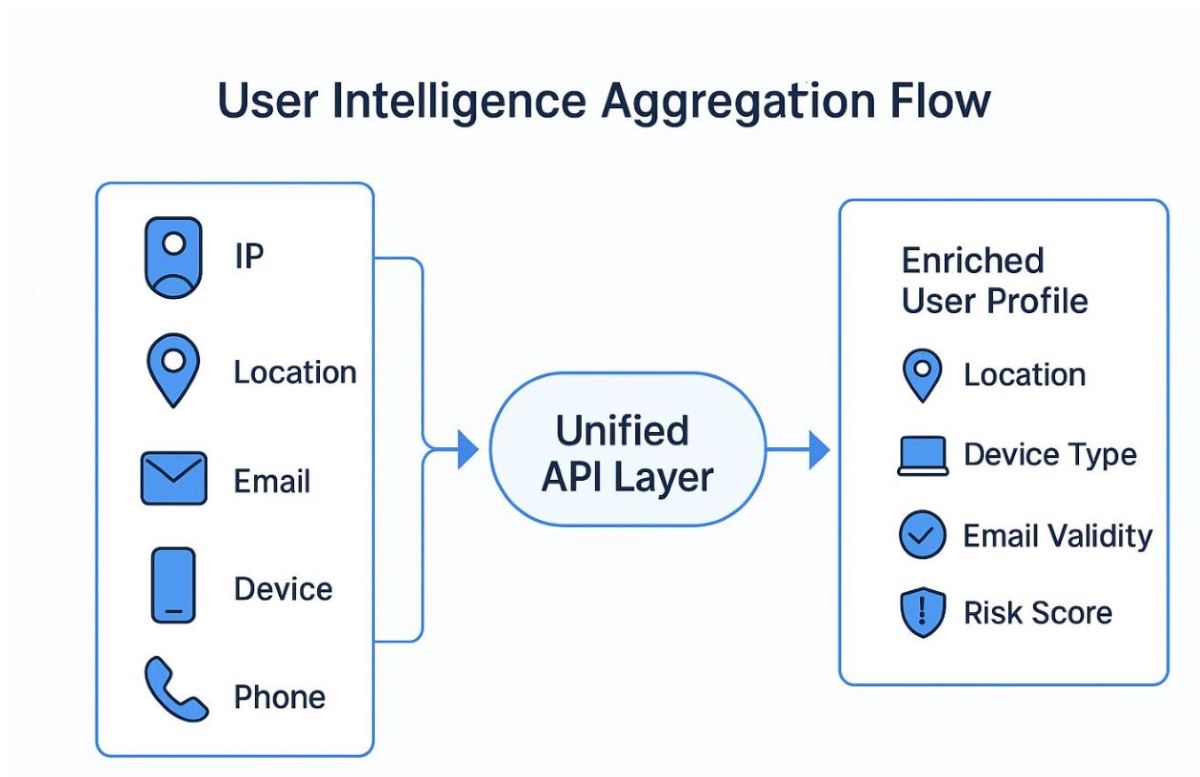
A single request to your unified API could coordinate calls to:
- IPstack for IP intelligence and geolocation
- Positionstack for forward or reverse geocoding
- Mailboxlayer for email verification
- Userstack for device and browser details
- Numverify for phone number validation
Instead of requiring your frontend to call all these services individually, you orchestrate everything server-side. The frontend receives one consolidated and consistently formatted response that contains all the information required for personalisation, security checks, or onboarding workflows.
This aggregation pattern reduces latency, improves data consistency, and ensures easier scaling as your application grows.
Example: Aggregating Currency and Financial Data Using APILayer
Another common use case is financial data aggregation. Teams often combine:
- Exchange Rates Data API
- CurrencyLayer API
- Metals API
- Market data or commodity pricing APIs
This lets developers create an internal pricing engine that produces consistent, real-time or historical financial calculations from a single endpoint.
For readers who want to explore free currency data providers, APILayer has a useful reference:
7 Best Free Currency Converter APIs in 2025
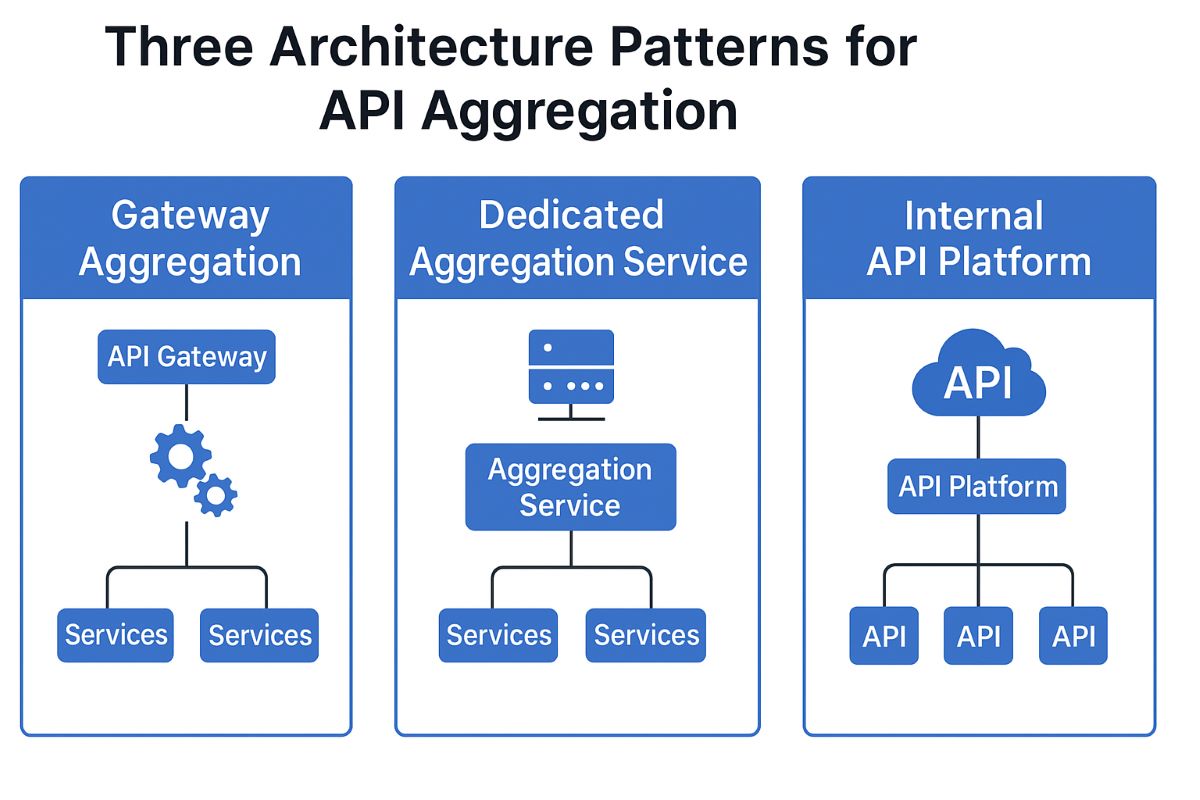
Real-World Architecture Patterns for API Aggregation
There are several patterns teams use depending on scale, latency needs, and system complexity.
Pattern One: Aggregation Inside an API Gateway
Many teams integrate aggregation logic directly inside their API gateway. This works for simple transformations or lightweight orchestration. It keeps everything in one place and avoids additional infrastructure.
Pattern Two: A Dedicated Aggregation Service
Larger systems benefit from a dedicated service that orchestrates backend calls. This service often handles:
- error management
- fallback logic
- caching
- schema validation
- routing based on vendor reliability
It also allows teams to scale orchestration independently of the gateway.
Pattern Three: A Full Internal API Platform
Enterprise organisations sometimes build internal API platforms acting as a hub for all external integrations. This approach provides:
- governance
- monitoring
- internal discovery
- consistent schemas
- version control
APILayer integrates well into this pattern because teams can rely on a unified ecosystem of high-quality APIs while designing the internal aggregation logic themselves.

When Should You Adopt API Aggregation?
Aggregation is highly valuable in certain scenarios and unnecessary in others. Teams adopt it when:
- multiple external data sources are required
- the frontend should not handle sensitive keys
- performance requires batching or caching
- the business expects to switch vendors in the future
- APIs provide inconsistent structures
- integrations need governance or auditing
However, a direct integration model may be simpler when:
- your application only depends on one external API
- latency must be as low as possible
- orchestration would add unnecessary overhead
Aggregation is a strategic choice. It is most beneficial when it reduces complexity, not when it adds an extra layer without clear operational advantage.
How APILayer Improves Aggregation Workflows
APILayer simplifies the aggregation journey because all APIs share:
- a consistent request format
- predictable pricing
- clear documentation
- scalable infrastructure
- reliable uptime
- unified support
This allows developers to select several APILayer products and combine them in a single internal API layer without dealing with the fragmentation that often comes from multi-vendor integrations.
If your team wants to explore geolocation services as part of an aggregation stack, this internal APILayer guide is a useful starting point:
5 Best Free Geolocation APIs in 2025
And if email validation is in your workflow, this post offers a deeper look:
Integrating Email Verification into Your Application Architecture
Explore the Full APILayer Marketplace
Browse the full collection of 20+ production-ready APIs and start assembling your unified API stack.
Explore All ProductsAdvanced Considerations and Tradeoffs
No architecture decision comes without tradeoffs. API aggregation brings significant advantages, but teams should also consider:
1. Increased Backend Responsibility
Your server becomes the orchestrator. This requires good monitoring, alerting, error handling, and observability.
2. Potential Latency Penalties
If sequential calls are required, response times can increase. This can be mitigated through:
- parallel requests
- caching
- prioritised vendor selection
- data freshness thresholds
3. Schema Governance
Your internal API must commit to stable schemas even when vendors change theirs.
4. Infrastructure Costs
While aggregation reduces client-side work, it shifts responsibility to the backend. This can mean additional compute, caching layers, or API gateway extensions.
The benefits typically outweigh the costs, especially when multiple teams depend on unified, consistent integrations.
Conclusion
API aggregation is becoming a central pattern in modern development. It helps organisations simplify integrations, reduce vendor complexity, unify authentication, and create scalable internal architectures. Whether you are building a user intelligence engine, a financial pricing system, or an internal data platform, aggregation provides a clean and maintainable foundation.
APILayer offers a robust ecosystem for this strategy. With consistent API design, reliable performance, and a wide range of data products, teams can build their aggregation layer faster and with significantly less operational risk.
Aggregation is not simply a technical choice. It is an architectural advantage that gives your organisation control over data quality, vendor flexibility, and long-term scalability.
Get Your Free API Keys!
Join thousands of developers using APILayer to power their applications with reliable APIs!
Get Your Free API Keys!100 Requests Free!
FAQs
What is API aggregation?
API aggregation combines multiple APIs behind a single interface so that clients only interact with one endpoint while backend services orchestrate calls to multiple vendors.
Is API aggregation the same as an API gateway?
No. An API gateway can perform simple transformations, but aggregation is a dedicated orchestration process that merges and structures responses from multiple sources.
When should I use API aggregation?
Aggregation is ideal when your application relies on several external APIs, when performance improvements are needed, or when you want to reduce client-side complexity.
Does aggregation increase latency?
It can, but latency can be optimised through parallelisation, caching, and carefully choosing which APIs to call synchronously versus asynchronously.
How does APILayer support aggregation?
APILayer offers a unified ecosystem of high-quality APIs for IP intelligence, geolocation, email validation, currency data, scraping, and more. This consistency makes APILayer an ideal foundation for internal aggregation layers.
Recommended Resource :
- OpenAI Function Calling: How to Connect LLMs to The Best Free APIs (2025)
- Step-by-Step Guide: How to Make Your REST APIs Accessible to AI Assistants Using MCPs
- How to Build a Scalable Web Scraping System Using Scrapestack API (2025 Guide)
- 10 APIs That Will Make Your Hackathon Project Stand Out