

APIs are no longer just integration tools, they’re products. And like any product, the experience they create determines whether developers adopt them, recommend them, or abandon them. A great API shouldn’t require guesswork, or endless debugging. It should guide developers from the start to production with clarity, predictability, and empathy.
In this blog, we break down the four dimensions of modern API Developer Experience (Platform, Usability, Reliability, and Empathy), a framework rooted in how real developers evaluate APIs in the real world. We’ll also explore how APILayer implements these principles to help teams build faster, scale safely, and deliver APIs developers
Table of Contents
Key Takeaways
- API Developer Experience (API DX) is shaped by four dimensions: Platform, Usability, Reliability, and Empathy.
- These dimensions align with how developers discover, explore, integrate, and operate your API.
- APILayer implements a cognitive, developer-first API strategy, including good error design, safe evolution, observability, and sandbox-ready tooling.
- Businesses and engineering teams can use these dimensions as a diagnostic framework to evaluate any API they consume or build.
APILayer’s ecosystem is purpose-built to optimize all four dimensions, enabling developers to ship faster with fewer integration failures.
Why API Developer Experience Matters
If you’ve ever integrated an API under a tight deadline, you know what “bad DX” feels like:
- ambiguous errors
- missing examples
- unstructured endpoints
- unknown rate limits
- unpredictable version changes
- tough to debug
Bad DX slows teams down. Great DX accelerates product development and reduces support load.
APILayer studied thousands of integrations and distilled API DX into four practical, measurable dimensions.
The Four Dimensions of API Developer Experience
Developers experience the APIs in stages. The journey typically moves through Discovery, Exploration, Integration, and Operation, and each stage introduces different expectations, questions, and friction points. Understanding these touchpoints helps product and engineering teams design APIs that guide developers smoothly instead of forcing them to decode complexity or guess next steps. Below is a breakdown of each phase and what developers need at that exact moment.
These dimensions reflect the real lifecycle developers follow:
DISCOVER
This is the moment a developer first encounters your API. Through search, documentation, marketplace, or recommendations. Their primary question is simple “What problem does this solve, and is it worth using?”
EXPLORE
Once interested, developers want to test without commitment. They’re looking for runnable examples, playgrounds, Postman collections, and reference docs they can skim. The question here becomes “Can I make my first successful request quickly?”
INTEGRATE
At this stage, the developer is actively building your API into their system or workflow. They now care about semantics, consistent schemas, authentication, SDKs, edge cases, and error handling. The core concern is “Will this continue to work reliably as I scale?”
OPERATE
Once in production, developer priorities shift to stability and observability. Monitoring tools, status pages, request_id tracing, changelogs, and safe versioning determine whether your API remains trusted long-term. The key question now becomes “Can I depend on this in production without worrying about breaking changes?”
And each stage corresponds to one DX dimension.
Let’s break them down.
1. Platform: The Foundation of Predictability, Semantics & Good Errors
Platform is not only about infrastructure, it’s about mental models and semantics.
An API with good Platform DX answers:
- Is our API intuitive?
- Is the schema predictable?
- Do errors tell developers exactly what to fix?
What Good Platform DX Looks Like
1. Predictability Over Cleverness
Means choosing clarity and consistency instead of shortcuts, tricks, or surprising behaviors. Developers should always know what an endpoint will do before they call it no hidden logic, no magic behavior, and no shifting patterns.
- Choosing a good endpoint:
api.example.com/users/{id}
Rather than,
api.example.com/getUsers/{id}
- Avoid file extensions in endpoints: .json, .xml, etc.
- Keep endpoints Lowercase: Lowercase paths prevent inconsistency across systems, clients, and coding styles.
- Use forward slashes to express hierarchy and not verbs or query decisions.
- Return predictable pagination structures when listing resources; Fields like total pages, next, and prev should follow a consistent contract across endpoints.
This uniformity builds trust and allows developers to focus on solving real problems.
2. Good Errors (More informative)
Developers don’t hate errors. They hate the ones that trap them for hours. A good error should show the way forward and point to the right resources to fix it fast.
Below shows a perfect example:
❌ Bad Error
{ "error": "invalid_input" }
✅ Good Error
					{
  "code": "invalid_customer_id",
  "message": "Customer 123 not found",
  "hint": "Create a customer (POST /customers) or use ?create=true",
  "request_id": "r_9a2b",
  "docs": "https://…"
}
Good errors reduce hours of debugging to seconds.
3. Cross-API Consistency
APILayer ensures a consistent experience across all APIs. Whether you’re using ipstack, currencylayer, mailboxlayer, or any other service. Authentication patterns, error formats, response models, and naming follow shared conventions, reducing onboarding friction and context switching.
This consistency allows developers to reuse mental models, tooling, and even code between products. This results in faster integration, less documentation dependency, and a smoother scaling path as needs grow.
How APILayer Implements Strong Platform DX
- Predictable schemas across 23 different APIs
- Human-friendly error objects with hints
- Consistent semantic layouts
- Contracts designed around developer mental models
Try APILayer’s clean API design and get 100 free requests.
2. Usability: Is Everything
If developers can’t make their first successful request in minutes, you’ve already lost them.
Usability is the single biggest catalyst for API adoption because developers judge an API within minutes. If they can’t achieve a successful first request quickly, frustration sets in and adoption drops. The initial experience determines trust and momentum. Winning early is winning entirely.
Key Questions for Usability
- Why do we have seven layers of authentication?
- Do we provide sandbox environments and Postman collections?
- Do we have runnable examples?
- Do we expose the telemetry developers need?
What Great Usability Looks Like
- Single-source authentication
- Postman collections, SDKs, and Quickstart guides
- Realistic use cases, not just raw endpoints
- Sandbox environments to experiment instantly
- Copy-paste-ready snippets
How APILayer Optimizes Usability
- All APIs come with a live playground, runnable examples, and Postman collections
- Unified API key mechanism across the entire platform
- Clear code samples in Python, JS, PHP, Java, Kotlin, Ruby & Go
- Developer telemetry for debugging
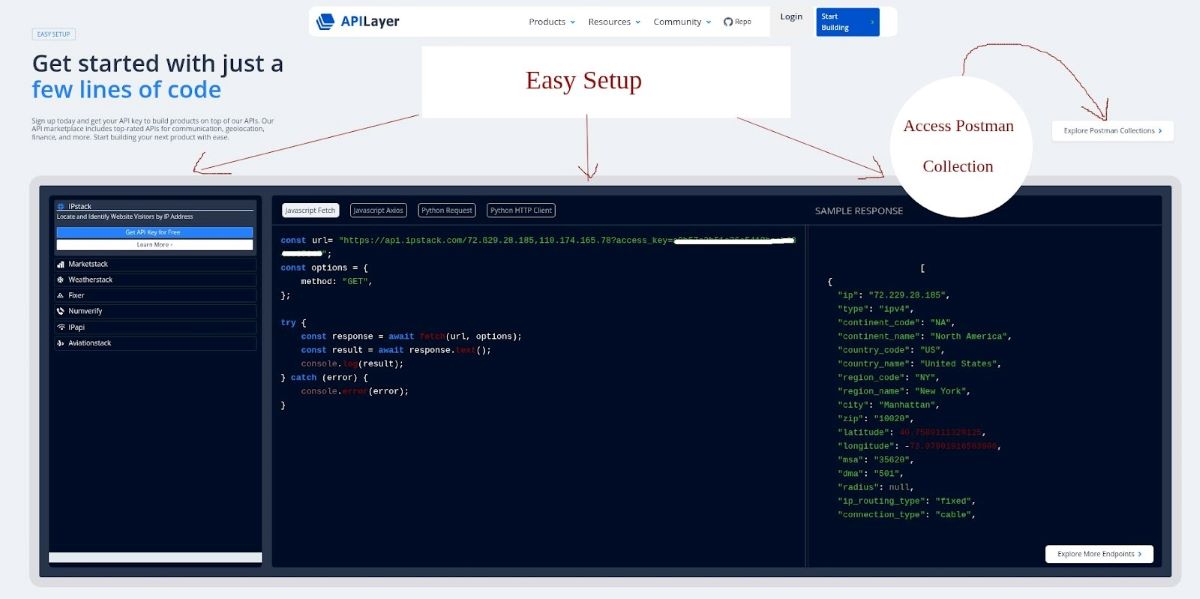
Make your first successful request now, Try APILayer Free.
3. Reliability: Uptime as well as Consistency
Developers don’t just integrate an API, they depend on it.
Reliability means predictability over time.
A public status page keeps developers informed, while graceful migrations prevent breaking changes during updates. Compatibility first versioning ensures stability across releases. Observability and logs give developers deep insight into system behavior when issues arise.
Key Reliability Questions
- Do updates break behavior?
- Is there a clear changelog and deprecation runway?
- Do developers get a traceable request_id?
- Can developers quickly check API status?
What Real Reliability Looks Like
- Every response includes a traceable request_id
- System status always visible

- Changelog page for transparent evolution
- Graceful migrations and long deprecation windows
- Observability built into request flows
How APILayer Ensures Reliability
- 99.99% uptime across global edge infrastructure
- Every API response includes request_id for debugging
Public status page and changelog
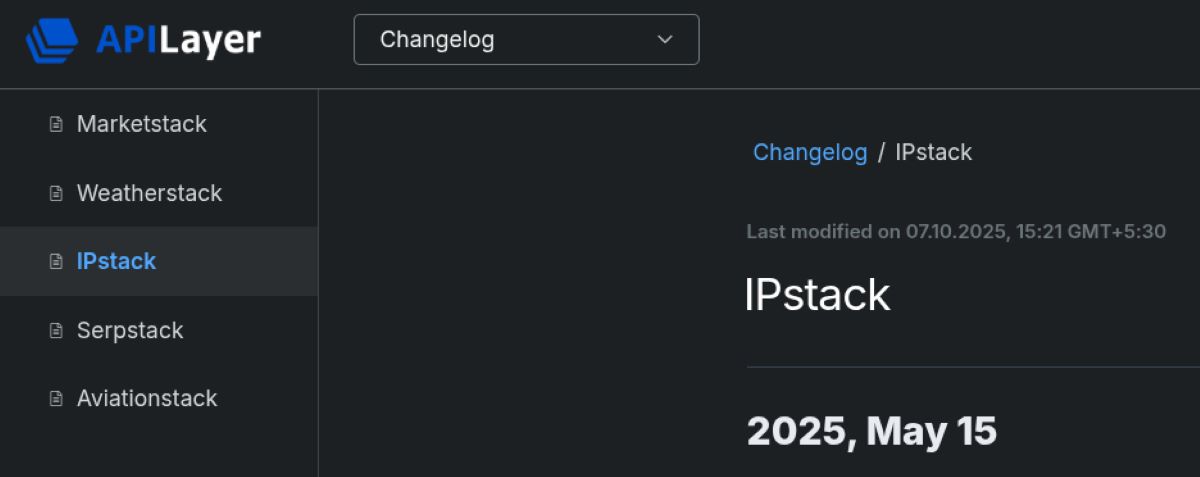
- Safe, compatibility-first version upgrades
- Intelligent rate-limiting and fair usage
Build production systems safely. Explore APILayer with a variety of products.
4. Empathy: The Most Overlooked API DX Dimension
Empathy means understanding developer needs under real-world constraints. It includes clear, human-readable docs, tutorials solving real workflows, helpful errors, and feedback loops to continuously improve the API.
This dimension answers:
- What would frustrate me if I had to integrate this API under time pressure?
- Are we writing docs like we’re talking to a human or a machine?
- Have we mapped real workflows and edge cases?
What Empathy Looks Like
- Human-friendly docs
- Edge case walkthroughs
- Developer-centered workflows
- Monthly “integration testing days”
- Real feedback loops with active iteration
How APILayer Demonstrates Empathy
- Clear, conversational documentation
- Tutorials for complex workflows (not just endpoints)
- Community feedback incorporated into API changes
- Real examples built from real customer scenarios
Experience empathetic API design, Explore APILayer documentation.
Get Your Free API Keys!
Join thousands of developers using APILayer to power their applications with reliable APIs!
Get Your Free API Keys!100 Requests Free!
Putting It All Together: A Practical API Developer Experience Evaluation Framework
Platform
- A strong Platform dimension starts with intuitive semantics that align with developer mental models and reduce friction. It delivers good, hint-rich errors that guide developers toward quick fixes.
- Its schema remains predictable across endpoints and versions, ensuring long-term stability. And by being agentic-ready, it supports modern AI-driven workflows and future-proof automation.
Usability
- A reliable API experience begins with a “Hello World” in under 10 minutes, ensuring developers achieve their first successful call quickly.
- Postman collections and SDKs streamline integration by offering ready-made tools and consistent workflows. A sandbox or playground environment lets developers test safely without risk to production systems.
- Clear onboarding and real use-case examples help teams understand how the API behaves in practical scenarios, reducing uncertainty and accelerating adoption.
Reliability
- A reliable API provides a request_id in every response, giving developers full traceability when debugging issues. It maintains a transparent public status page so teams can instantly verify system health.
- Reliability also means safe, graceful migrations supported by compatibility-first versioning that never breaks existing integrations. With built-in observability and structured logs, developers gain the visibility they need to operate confidently in production.
Empathy
- Empathy-focused APIs provide human-readable documentation that speaks to developers, not machines. They anticipate edge cases and surface them clearly, reducing time spent troubleshooting.
- Feedback loops ensure the product evolves based on real developer needs. Tutorials built around real workflows, and written in developer-first language, help teams ship faster with fewer surprises.
- APILayer is purpose-built around this exact model, because it’s based on how real developers evaluate real APIs.
Start Building Developer Experiences
APILayer is trusted by millions of developers and companies to provide consistent, reliable, and developer friendly APIs.
- Try any APILayer API free (100 requests included)
- Test APIs in the Postman
- Checkout more APILayer products
Whether you’re a developer, SMB, or enterprise team. APILayer gives you the DX foundation your product deserves.
FAQs
1. What makes the four dimensions of API Developer Experience different from typical guidelines?
They’re based on real integration patterns: Discover → Explore → Integrate → Operate.
They reflect what developers actually experience, not theoretical best practices.
2. What does “Empathy” mean in the context of API design?
Empathy means understanding developer needs under real-world constraints. It includes clear, human-readable docs, tutorials solving real workflows, helpful errors, and feedback loops to continuously improve the API.
3. How does Reliability impact real-world API usage?
Reliability goes beyond uptime, it includes request tracing (request_id), changelogs, safe versioning, observability, and transparent status communication. These elements ensure stable, predictable usage at scale.
4. How does APILayer reduce debugging time?
Through good error objects, request IDs, a status page, logs, and consistent response bodies.
5. What makes APILayer’s DX approach different?
APILayer uses the exact four-dimension framework described above, along with real developer workflows, integration days, and feedback loops.
Recommended Resource :
- API Aggregation Strategy: A Comprehensive Guide
- 10 Free & Affordable APIs Every Startup Developer in 2025 Should Know About
- How to Build a Real-Time Weather Dashboard Using the Weatherstack API (Step-by-Step)