


You’re building a REST API and you need to lock it down. You’ve got three main options, API Keys, JWT, and OAuth 2.0. They’re not interchangeable, and picking the wrong one will either leave you exposed or buried in unnecessary complexity.
This guide breaks down OAuth vs API Keys vs JWT in a way that helps you make a clear, defensible decision, not just understand the theory.
Table of Contents
Why This Decision Matters Right Now
In 2026, most systems are API-first. Your frontend, mobile app, internal services, third-party integrations, everything talks through APIs.
That means your authentication layer is no longer a detail. It’s your front door.
Here’s what goes wrong when you pick the wrong method:
- Over-engineering: You implement full OAuth 2.0 for a simple internal service. Now you’re maintaining an auth server, token lifecycle, scopes, for no real gain.
- Under-securing: You expose a public API with just API keys. Keys get leaked, reused, or abused, and now you’re rate-limiting instead of preventing misuse.
- Scaling pain: You start with API keys, then later need per-user permissions. Retrofitting OAuth becomes painful.
- Zero-trust mismatch: Modern architectures assume no implicit trust. Weak auth methods don’t hold up.
In short: this isn’t just a security decision, it’s a product and architecture decision.
If you’re designing APIs today, this belongs right alongside your database and system design choices.
How Each Method Actually Works
Let’s strip away the buzzwords and look at what actually happens on the wire.
API Keys (Simple Identifier-Based Auth)
API keys are the simplest thing that could work.
Flow
Client → Request (with API Key) → Server → Validate Key → Respond
Step-by-step
- Server generates a unique API key (e.g., sk_live_abc123)
- Client stores it (env variable, config, etc.)
- Client sends request:
GET /data
Header: apikey: YOUR_API_KEY
- Server:
- Looks up the key
- Checks if valid / active
- Applies rate limits / quotas
- Returns response
Important truth
API keys are not a full authentication protocol. They’re just identifiers.
They don’t inherently:
- Prove identity strongly
- Support user-level permissions
- Expire automatically (unless you build it)
Checkout the Blog: https://blog.apilayer.com/what-is-api-access-api-keys-authentication-rate-limits-and-common-errors-explained/
JWT (JSON Web Tokens)
JWT is a token format, not a full authentication system.
Structure
header.payload.signature
Example:
eyJhbGciOiJIUzI1NiIsInR5cCI6IkpXVCJ9…
Flow
Client → Login → Server issues JWT → Client sends JWT → Server validates → Respond
Step-by-step
- User logs in
- Server creates JWT:
- Header: algorithm (HS256/RS256)
- Payload: user ID, roles, expiry
- Signature: cryptographic proof
- Client stores token (usually in memory or secure storage)
- Client sends:
Authorization: Bearer <JWT>
- Server:
- Verifies signature
- Checks expiration
- Reads claims (user ID, roles)
- Returns response
Key idea
JWTs are stateless, the server doesn’t need to store sessions.
OAuth 2.0 (Delegated Authorization Framework)
OAuth 2.0 is not just auth, it’s a delegation system.
Two flows you actually care about:
1. Authorization Code Flow (User-based access)
User → Login via Provider → Authorization Server → Access Token → API
Steps:
- User clicks “Login with X”
- Redirected to authorization server
- User logs in and consents
- Server returns authorization code
- Client exchanges it for:
- Access token
- Refresh token
- Client calls API using access token
2. Client Credentials Flow (Service-to-service)
Service → Auth Server → Access Token → API
Steps:
- Service sends client ID + secret
- Gets access token
- Uses token to call APIs
Key components
- Authorization Server
- Access Tokens
- Refresh Tokens
- Scopes (permissions)
Important truth
OAuth often uses JWT under the hood, but adds:
- Delegation
- Permissions
- Token lifecycle
OAuth vs API Keys vs JWT — Honest Comparison
Here’s the part you actually care about:
Dimension | API Keys | JWT | OAuth 2.0 |
Security level | Low–Medium (easy to leak, static) | Medium–High (signed, expirable) | High (delegation, scopes, rotation) |
Implementation complexity | Very low | Medium | High |
Best for | Simple APIs, public data, quick integrations | Internal APIs, auth sessions | Third-party access, user delegation |
Statefulness | Stateless (lookup required) | Stateless | Mostly stateless (with token infra) |
Token expiration | Manual (if implemented) | Built-in (exp claim) | Built-in (access + refresh tokens) |
Supports scopes/permissions | Limited | Custom (in payload) | First-class support |
Revocability | Hard (rotate key) | Medium (blacklist if needed) | Strong (revoke tokens) |
Suitable for third-party access | Limited | Not ideal alone | Yes (primary use case) |
Decision Tree (What Should You Use?)
Let’s make this practical.
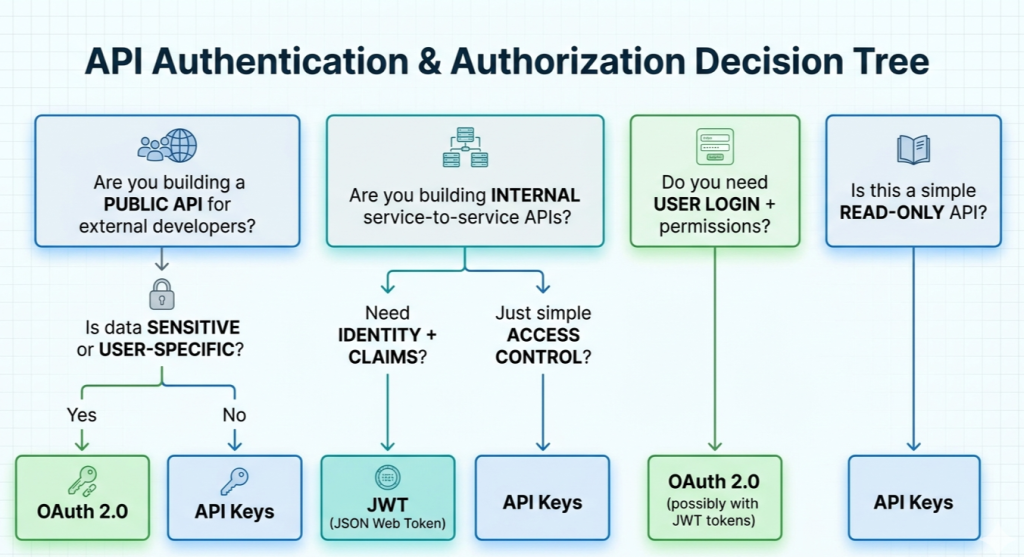
Clear recommendations
- Public data APIs (weather, IP, exchange rates) → ✅ API Keys
- Internal microservices → ✅ JWT
- User login + third-party integrations → ✅ OAuth 2.0
- High-security enterprise APIs → ✅ OAuth 2.0 + JWT
Real-World Example: Why APILayer Uses API Keys
APILayer is a great example of where API keys are the right choice.
They offer:
- Exchange rates
- IP geolocation
- Market data
These are:
- Mostly read-only
- Not user-specific
- High-volume, developer-friendly
Why API Keys make sense here
- Fast onboarding (no OAuth flow)
- Minimal friction for developers
- Easy to integrate into scripts, backend jobs
- Scales well with rate limiting
Working Example (APILayer API)
Let’s call the Exchange Rates API.
cURL
curl "https://api.exchangerate.host/live?access_key=YOUR_KEY&base=USD&symbols=EUR"
Python (requests)
					import requests

url = "https://api.exchangerate.host/live"

params = {
"access_key": "YOUR_KEY",
"base": "USD",
"symbols": "EUR"
}

response = requests.get(url, params=params)

print(response.json())
Real API Response
					{
   "success": true,
   "terms": "https://currencylayer.com/terms",
   "privacy": "https://currencylayer.com/privacy",
   "timestamp": 1771758026,
   "source": "USD",
   "quotes": {
       "USDAED": 3.672498,
       "USDAFN": 63.999812,
       "USDALL": 82.022626,
       "USDAMD": 376.059891,
       "USDAOA": 917.00033
       …
       …
       …
       …
   }
}
📘 Documentation: https://docs.apilayer.com/Exchangerate/docs/api-documentation
When API Keys Are Enough
This example shows:
- No user identity required
- No delegated access
- Simple request-response
API keys are perfect here.
When You’d Upgrade
You’d move to OAuth if:
- Users connect their own accounts
- Data becomes private
- You need fine-grained permissions
Security Best Practices
Even the “right” choice can go wrong if implemented poorly.
API Keys
- Rotate keys regularly
- Never send in query parameters (use headers)
- Store in environment variables (never hardcode)
- Add rate limiting and usage quotas
JWT
- Use short expiration times
- Prefer RS256 over HS256 for public APIs
- Always validate:
- Signature
- Expiration
- Issuer
- Never store sensitive data in payload
OAuth 2.0
- Use PKCE for public clients
- Always enforce HTTPS
- Strictly validate redirect URIs
- Store tokens securely (no localStorage for sensitive apps)
Final Takeaway
If you remember one thing from this OAuth vs API Keys vs JWT comparison, let it be this:
- API Keys → simplest, best for public data APIs
- JWT → best for internal systems and stateless auth
- OAuth 2.0 → best for user-based and third-party access
Don’t over-engineer. Don’t under-secure. Pick the tool that matches your use case.
What Should You Do Next?
Here’s something concrete:
- If you’re unsure → start with API keys and validate your use case
- If you need user auth → move to OAuth early
- If you’re scaling microservices → adopt JWT-based auth
