

Web scraping in 2026 has evolved into a mission-critical capability for companies that rely on real-time data. From price intelligence and SEO monitoring to lead generation and market research, access to reliable web data is now a competitive advantage, not a nice-to-have.
However, scraping modern websites is harder than ever. JavaScript-heavy frontends, advanced bot detection, fingerprinting, geo-restrictions, and dynamic content delivery have made traditional scraping scripts fragile and costly to maintain.
This is why web scraping APIs have become the default choice for developers, SMBs, and enterprise teams alike.
In this guide, we break down the best web scraping APIs for 2026, with a primary focus on Scrapestack, Zenscrape, and other leading solutions. By the end of this article, you’ll be able to confidently select the right scraping API based on your technical needs, scale, and budget.
Table of Contents
Key Takeaways
- Scrapestack offers the fastest path from idea to production with minimal configuration and predictable results.
- Zenscrape is well-suited for JavaScript-heavy websites and dynamic content.
- Enterprise platforms like Zyte and Bright Data provide advanced capabilities but introduce higher cost and operational complexity.
- API-first scraping is safer, more scalable, and easier to maintain than custom scraping stacks.
- Choosing the right scraping API in 2026 depends on success rate, ease of use, rendering needs, and pricing transparency.
What Is a Web Scraping API?
A web scraping API is a hosted service that fetches and returns website content on your behalf. Instead of sending requests directly to a target website, you send a request to the API, which handles:
- Proxy rotation and IP management
- Request headers and browser simulation
- CAPTCHA and bot detection avoidance
- JavaScript rendering (if needed)
- Error handling and retries
The result is clean, reliable data delivered via a simple REST interface.
If you’re evaluating APIs early in development, APILayer’s guide on validating APIs before coding is a useful reference for avoiding costly implementation mistakes later.
Why Web Scraping Is More Challenging in 2026
Modern websites are no longer static HTML pages. Most production sites today rely on:
- Client-side rendering frameworks (React, Vue, Angular)
- Lazy-loaded content and API-driven data fetching
- Behavior-based bot detection
- IP reputation scoring and rate limits
- Browser fingerprinting and headless detection
Or can say, most production sites now rely on client-side rendering frameworks such as React, Vue, and Angular, combined with lazy-loaded content and API-driven data fetching. At the same time, they implement advanced protection mechanisms like behavior-based bot detection, IP reputation scoring, strict rate limits, and browser fingerprinting to identify and block headless or automated access.
For developers, this means that a scraper that works today may fail tomorrow, often without warning.
Maintaining an in-house scraping setup requires:
- Constant proxy rotation
- Browser automation tools
- CAPTCHA-solving services
- Monitoring and retry logic
- Infrastructure scaling and maintenance
This is exactly where web scraping APIs provide value: they abstract away this operational burden so teams can focus on using data rather than fighting for access to it.
Criteria Used to Evaluate the Best Web Scraping APIs
To accurately compare the best web scraping APIs, we evaluated each solution across a set of practical, developer-focused criteria. These factors directly impact reliability, implementation speed, and long-term scalability in real-world projects.
Reliability and Success Rate
A web scraping API must consistently return valid responses across a wide range of websites, including those with aggressive bot protection. High success rates are critical for production use cases where missing or incomplete data can break downstream systems.
Ease of Integration
The best scraping APIs offer clear documentation, intuitive request parameters, and predictable response formats. Developers should be able to integrate the API into an existing codebase within minutes, not days, without relying on custom workarounds.
JavaScript Rendering Support
Many modern websites rely heavily on client-side JavaScript to load content. An effective scraping API should support JavaScript rendering when static HTML is insufficient, ensuring accurate data extraction from single-page applications and dynamic interfaces.
Performance and Latency
Scraping APIs should deliver fast response times without introducing unnecessary overhead. Low latency is especially important for real-time applications such as price monitoring, alerting systems, and live dashboards.
Pricing and Scalability
Transparent pricing models allow teams to scale confidently from small experiments to enterprise-level workloads. The ideal API supports gradual growth without sudden cost spikes or complex billing structures.
Scrapestack: Best Web Scraping API for Speed, Simplicity, and Scale
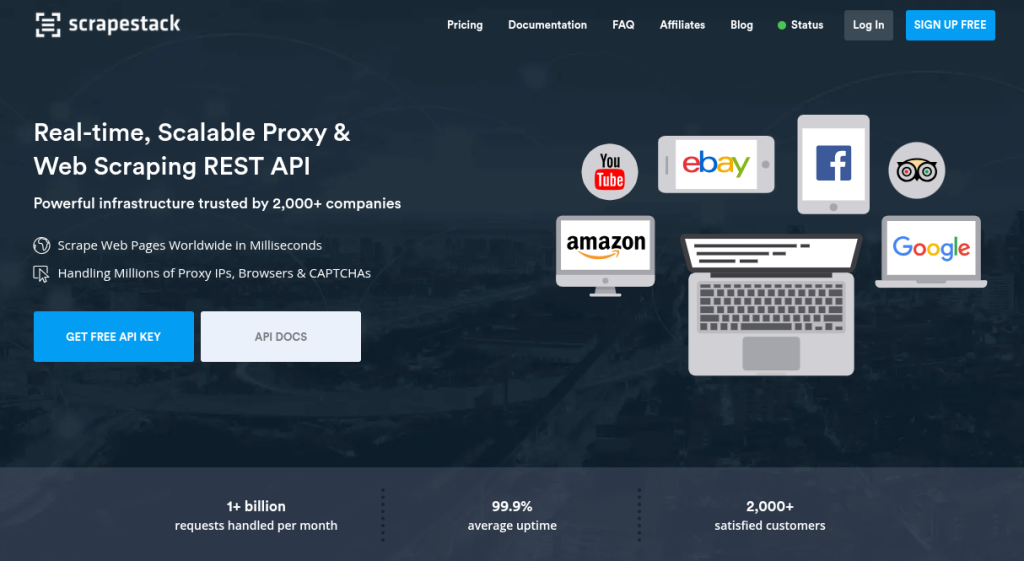
Scrapestack stands out in 2026 as one of the most practical and developer-friendly web scraping APIs on the market. It is designed for teams that want reliable scraping without managing infrastructure or dealing with complex configurations.
Core Features
- REST-based scraping API with simple query parameters
- Automatic IP rotation and bot mitigation
- High success rates across common scraping targets
- Supports raw HTML extraction and page content retrieval
- Global infrastructure for low-latency requests
Real-World Example: Monitoring Competitor Prices for an E-commerce Platform
Imagine an e-commerce startup that sells electronics online and wants to stay competitive by tracking prices, availability, and discounts on major marketplaces and competitor websites. These sites update prices frequently, and manually checking them, or relying on outdated data, can lead to lost sales and poor pricing decisions.
To solve this, the engineering team integrates Scrapestack by APILayer into their backend system.
Using Scrapestack’s REST-based scraping API, the team simply sends HTTP requests with query parameters containing the target product URLs. There’s no need to manage headless browsers, proxies, or complex scraping logic. Scrapestack handles everything behind the scenes and returns either raw HTML or extracted page content that the system can parse for price, stock status, and promotional banners.
Because most large e-commerce sites actively block bots, the platform relies heavily on Scrapestack’s automatic IP rotation and bot mitigation. This ensures that requests don’t get blocked or rate-limited, even when scraping thousands of product pages daily. The high success rate across common scraping targets means the pricing engine consistently receives accurate, up-to-date data without constant maintenance or failures.
The startup also benefits from Scrapestack’s global infrastructure, which routes requests through geographically optimized servers. This results in low-latency responses, especially when scraping region-specific sites that serve different content based on user location. Faster responses allow the pricing system to update listings multiple times per day without impacting application performance.
With Scrapestack in place, the business can automatically adjust prices, trigger alerts when competitors run promotions, and make data-driven decisions, all without building or maintaining a fragile scraping infrastructure.
Why Scrapestack Works So Well
Scrapestack follows a “send a URL, get the data” philosophy. There’s no need to manage headless browsers, rotate proxies manually, or tune anti-bot strategies. This makes it especially appealing for developers who want to move fast.
It also integrates cleanly into existing workflows, whether you’re building a backend service, scheduled data pipeline, or internal dashboard.
Common Use Cases
- Price tracking and competitor monitoring
- SEO audits and SERP scraping
- Content aggregation and news monitoring
- Market research and data enrichment
- Internal tools and MVPs
Scrapestack is also ideal when paired with APILayer’s browser-based API testing tools, allowing developers to validate scraping results before writing production logic.
Get free 100 requests with Scrapestack
Try the Scrapestack API free
Zenscrape: Strong Choice for JavaScript-Rendered Websites
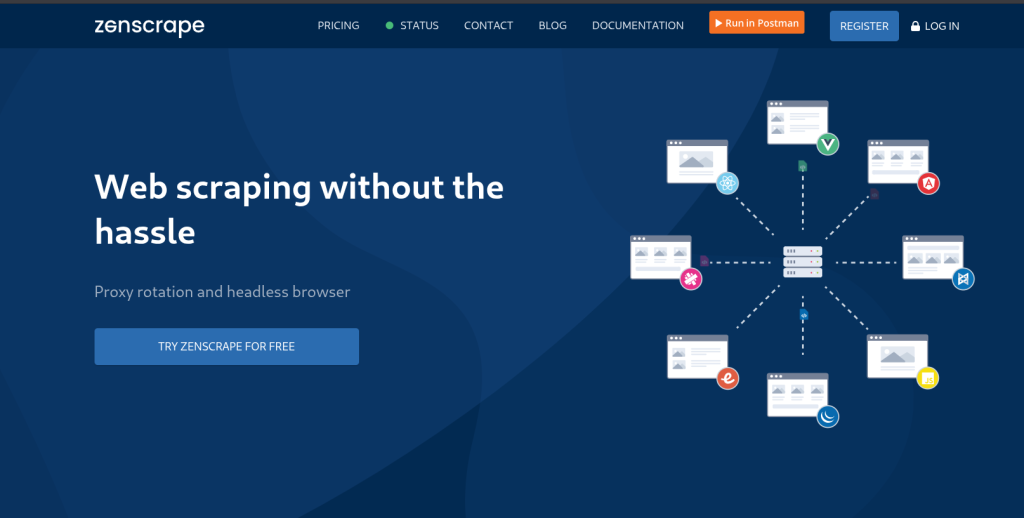
Zenscrape focuses heavily on rendering modern web applications that rely on client-side JavaScript.
Key Capabilities
Headless browser rendering
Support for dynamic DOM updates
Screenshot and PDF generation
Structured data extraction options
Real-World Example: Extracting Data from JavaScript-Heavy Websites for Market Research
Consider a market research company that analyzes trends across modern web platforms—such as SaaS pricing pages, travel booking sites, or job portals. These websites rely heavily on JavaScript, meaning their content loads dynamically after the initial page request. Traditional HTML scraping tools fail because the data simply isn’t present in the raw source.
To solve this, the company integrates Zenscrape by APILayer into its data collection pipeline.
Using Zenscrape’s headless browser rendering, each target page is fully loaded just like it would be in a real user’s browser. JavaScript executes normally, allowing the page to fetch data, update the DOM, and render dynamic components such as tables, filters, and interactive charts. This ensures that the scraper captures the final, rendered state of the page rather than incomplete HTML.
Because many pages update content asynchronously, the platform leverages Zenscrape’s support for dynamic DOM updates to wait until specific elements appear before extracting data. This makes it possible to reliably collect information such as job listings, pricing tiers, availability calendars, or real-time metrics without brittle timing hacks.
For reporting and compliance needs, the team also uses Zenscrape’s screenshot and PDF generation capabilities. Each scrape produces a visual snapshot of the page at the time of data collection, which is useful for audits, client reports, or historical comparisons when website content changes.
Finally, instead of manually parsing messy HTML, the company relies on Zenscrape’s structured data extraction options to return clean, machine-readable data. This structured output feeds directly into analytics dashboards and internal tools, significantly reducing post-processing effort.
With Zenscrape, the research team can consistently extract reliable data from complex, JavaScript-driven websites—without maintaining headless browser infrastructure or constantly rewriting scrapers.
Where Zenscrape Excels
If your scraping targets rely on delayed API calls or dynamic UI components, Zenscrape’s rendering engine can be extremely helpful.
Limitations
JavaScript rendering increases:
Latency per request
Resource consumption
Cost at higher volumes
As a result, Zenscrape is best suited for selective scraping tasks rather than high-volume crawling.
Try Zenscrape with a free trial
Zyte API: Built for Enterprise-Scale Scraping Operations
Zyte positions itself as a comprehensive data extraction platform rather than a lightweight scraping API.
Features
AI-powered extraction pipelines
Advanced proxy and fingerprint management
Compliance tooling for large organizations
SLA-backed performance guarantees
Real-World Example: Job Listings Aggregation at Scale
A job market analytics platform needs to collect job postings from hundreds of company career pages and job boards. These sites vary widely, some are static, others are JavaScript-heavy, and many actively block bots.
By integrating the Zyte API, the platform sends each job URL as a simple request. Zyte automatically handles rendering when needed, manages IP rotation and bot mitigation, and returns clean, structured job data such as role, company, location, and posting date. This allows the team to scale globally without maintaining scraping infrastructure or custom logic per site.
Architecture Diagram
Job URLs
|
v
Backend Service
|
v
Zyte API
|
|– Smart Fetching (HTTP / Browser Rendering)
|– Bot Mitigation & IP Rotation
|– Structured Data Extraction
v
Normalized Job Data
|
v
Analytics Dashboard / Reports
This setup enables the platform to reliably track hiring trends across regions while focusing engineering effort on data analysis instead of scraping complexity.
Limitations
Higher cost of ownership
Longer onboarding and setup time
More complexity than most teams need
For many developers and SMBs, Zyte is powerful, but excessive.
Bright Data and Oxylabs: Maximum Control, Maximum Complexity
Bright Data and Oxylabs are best known for their massive proxy networks and fine-grained control.
Strengths
Extremely high success rates
Residential and mobile IP coverage
Advanced targeting and customization
Real-World Use Case: Bright Data
A global e-commerce intelligence company monitors product pricing, availability, and promotions across thousands of retail websites in different countries. These sites aggressively block automated traffic and vary content based on user location and device type.
Bright Data is used to route requests through residential and mobile IPs, ensuring that each request appears as a real consumer visit from a specific region. With advanced targeting, the team can scrape country-specific pricing, mobile-only discounts, and localized inventory data. The extremely high success rate is critical because even small data gaps can distort pricing models used by downstream analytics and forecasting systems.
Real-World Use Case: Oxylabs
A large market research firm collects large-scale SERP and marketplace data for enterprise clients across multiple verticals, including travel, fintech, and retail. The data must be accurate, geo-specific, and refreshed frequently to support time-sensitive insights.
Oxylabs provides high-quality residential and mobile IP coverage, allowing the firm to reliably access search results and listings from different regions without triggering blocks. Its advanced customization and targeting controls enable precise request behavior, ensuring consistent data extraction at scale. The high success rate reduces retries and operational overhead, which is essential when processing millions of requests per month.
Why Teams Choose Bright Data or Oxylabs
Both platforms are best suited for organizations where data accuracy, geo-specific targeting, and scale matter more than cost or simplicity. While they require more setup and higher investment, they deliver unmatched reliability for mission-critical, large-volume scraping operations.
These platforms are best suited for companies whose core business depends on large-scale data extraction.
Limitations
Steep learning curve
Expensive pricing models
Requires scraping expertise
Pricing Comparison: Cost vs Value in Web Scraping APIs (2026)
Web scraping API pricing in 2026 typically follows a usage-based model, but the total cost varies significantly depending on rendering, infrastructure, and scale. Scrapestack offers one of the most accessible pricing structures, starting with a free tier and scaling through monthly and yearly plans that charge primarily on a per-request basis, making it cost-efficient for developers and SMBs. Zenscrape pricing is also request-based but increases faster due to JavaScript rendering and headless browser usage. Enterprise platforms like Zyte, Bright Data, and Oxylabs usually rely on custom monthly or yearly contracts, often with minimum commitments, where costs rise sharply as request volume, proxy usage, and advanced features are added.
API | Per-Request Cost (Approx.) | Monthly Plans | Yearly Plans | Best Value For |
Scrapestack | Low-cost per request | Affordable, flexible tiers | Discounted annual plans | Developers, SMBs, startups |
Zenscrape | Medium (higher with JS rendering) | Mid-range plans | Annual savings available | Dynamic websites |
Zyte | High (bundled pricing) | Enterprise-only | Long-term contracts | Large enterprises |
Bright Data | Very high | High minimum spend | Contract-based | Massive-scale scraping |
Oxylabs | Very high | Enterprise pricing | Annual commitments | Data-intensive teams |
Comparison Table: Best Web Scraping APIs for 2026
API | Best For | Ease of Use | JS Rendering | Cost |
Scrapestack | Fast, scalable scraping | ⭐⭐⭐⭐⭐ | Optional | Low |
Zenscrape | Dynamic sites | ⭐⭐⭐⭐ | Yes | Medium |
Zyte | Enterprise-scale scraping | ⭐⭐⭐ | Yes | High |
Bright Data | Full control | ⭐⭐ | Yes | Very High |
Oxylabs | Large-scale, geo-targeted scraping | ⭐⭐ | Yes | Very High |
How to Choose the Right Web Scraping API in 2026
When selecting a scraping AP, ask:
Do I need JavaScript rendering, or is HTML enough?
How fast do I need to deploy?
What is my expected request volume?
Do I want simplicity or maximum control?
Is pricing predictable as I scale?
For most developers and growing teams, Scrapestack offers the best balance of performance, simplicity, and cost.
Final Verdict: The Best Web Scraping API for 2026
If your goal is to ship faster, reduce operational overhead, and reliably extract web data at scale, Scrapestack is the top recommendation for 2026.
It removes the complexity of scraping while remaining flexible enough for production workloads.
Get started with Scrapestack – 100 free requests
FAQs:
1. Are web scraping APIs legal?
Yes, when used responsibly and in compliance with applicable laws and website terms.
2. Do scraping APIs still need proxies?
No. Scraping APIs manage proxies internally.
3. Which API is best for beginners?
Scrapestack, due to its simple REST interface and minimal setup.
4. Can scraping APIs bypass CAPTCHAs?
Most modern APIs handle CAPTCHA challenges automatically.
