


Table of Contents
Key Takeaways
- Historical rates turn multi-currency records into audit-ready statements, consistent forecasts, and reproducible payroll calculations.
- A historical exchange rate API minimises manual work, shortens close cycles, and lowers audit exposure with time-stamped, source-traceable data.
- The ExchangeRateData API offers enterprise-grade coverage and reliability for teams integrating forex data across ERP, EPM, BI, and payroll systems.
- Complementary tools from APILayer, such as the Fixer API and Mailboxlayer API, strengthen financial operations with verified data and dependable automation.
Explore ExchangeRateData API
Explore currency exchange rate coverage, API endpoints, documentation, and SLA options to find the right solution for your application.
Explore API & DocumentationExplore documentation and SLA options
You Will Learn
- Why historical exchange rates are essential for consolidated reporting accuracy.
- How consistent rate sources support tax compliance and audit readiness.
- Ways to enhance forecasting and budgeting using historical data.
- How to automate cross-border payroll with precise pay-period conversions.
- How APIs simplify multi-currency reconciliations and improve transparency.
- Key evaluation criteria for choosing a dependable enterprise financial planning API.
Introduction
Managing finance across multiple currencies is no longer optional — it’s built into how global businesses operate. Subsidiaries bill in one currency, suppliers invoice in another, and the treasury needs to consolidate everything back to a reporting currency. Without reliable historical rates, these conversions become inconsistent, introducing discrepancies that ripple through reports, forecasts, and audits.
A historical exchange rate API provides a single, authoritative data source. It delivers accurate, time-stamped rates for any past date, ensuring all conversions follow the same logic. By integrating it directly into ERP, BI, and payroll tools, finance teams eliminate manual rate lookups, improve reporting accuracy, and close faster.
CTA: Get 100 Free Monthly Requests
Example: Retrieving Historical Exchange Rates via API
curl "https://api.exchangeratesapi.io/v1/2023-01-01?access_key=YOUR_ACCESS_KEY&base=USD&symbols=EUR,GBP"
This returns historical rates, timestamp, base currency ,symbol conversions
Why Historical Exchange Rate APIs Matter for Enterprise Finance
Rates used on transaction or accrual dates underpin every accurate multi-currency report. If conversions differ between systems or entities, financial results drift apart. Historical exchange rate data acts as the backbone for unified reporting and reliable audits.
Signs your organisation needs a better solution include:
- Discrepancies between local ledgers and group reporting.
- Manual spreadsheet lookups that delay close cycles.
- Audit questions about how rates were chosen or stored.
- Forecast models that fluctuate unpredictably due to inconsistent FX data.
By using a consistent API source, enterprises enforce a single standard for all conversions, strengthening governance and trust in reported numbers.
Use Case One: Financial Reporting Accuracy
The challenge
Consolidated reporting can collapse when teams use different rate sources. Copy-pasting from websites or inconsistent lookup tables introduces errors that compound across entities.
The solution
A historical exchange rate API like ExchangeRateData ensures all subsidiaries use identical rates for the same dates. Whether applying daily closing or monthly average rates, finance can automate conversions with traceable, date-stamped data.
Benefits
- Fewer post-close adjustments and faster consolidation.
- Reliable audit trails for every rate used.
- Transparent methodology across systems.
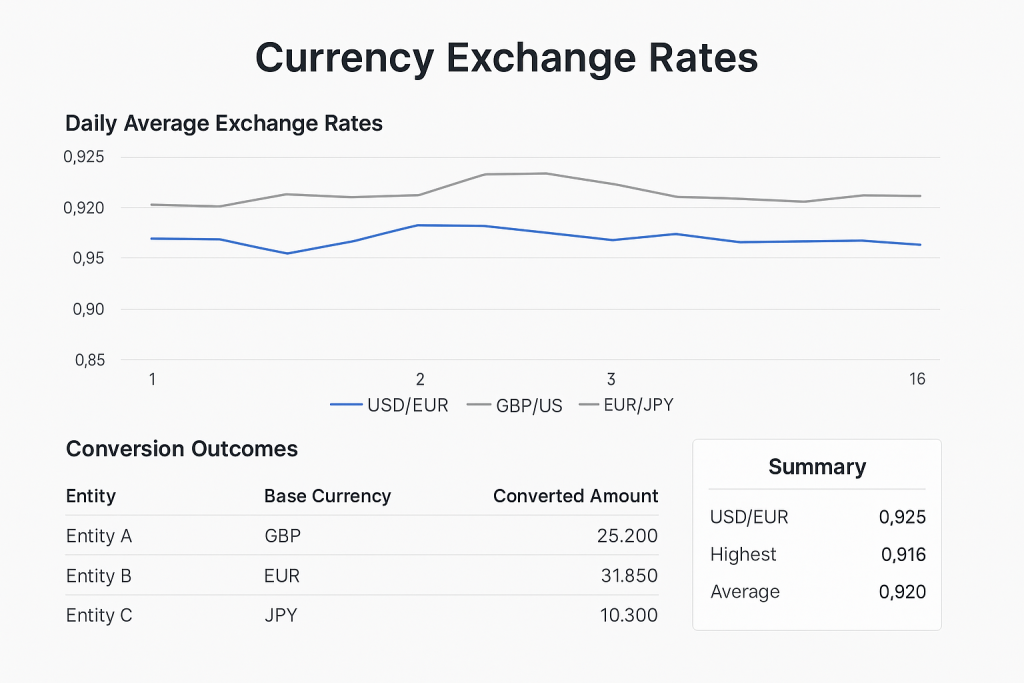
Visual idea: a dashboard snapshot showing currency pairs, daily averages, and conversion outcomes for multiple entities.
Use Case Two: Tax Compliance and Audit Readiness
The challenge
Tax authorities expect consistent exchange rate usage in financial statements. Missing documentation or inconsistent sources trigger delays, fines, or even re-filing.
The solution
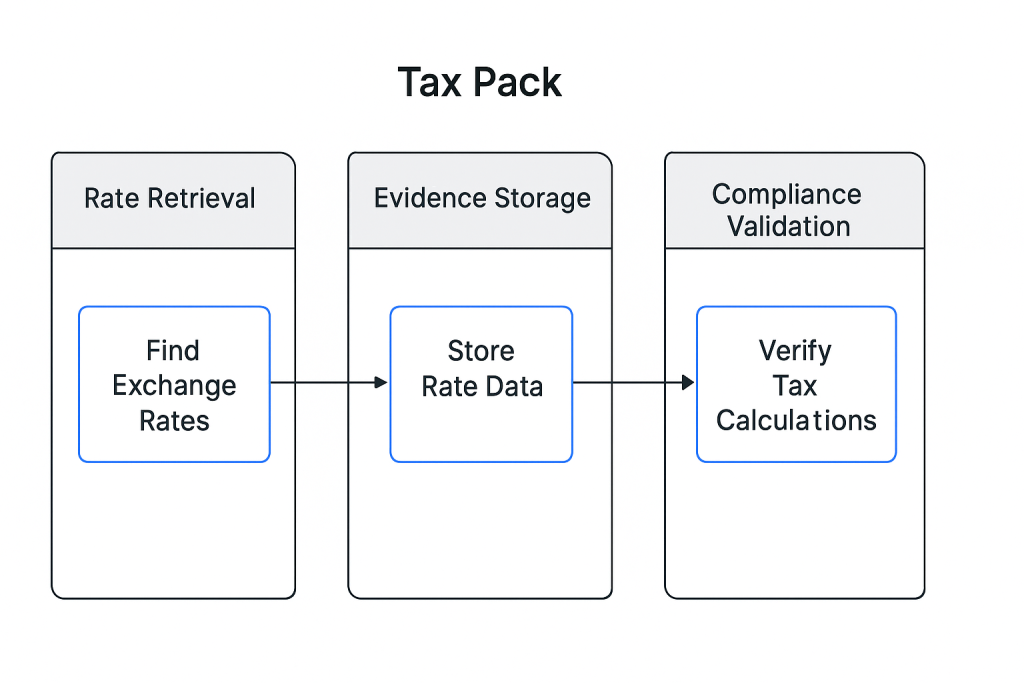
A single API-based rate source guarantees standardised conversions. Each retrieved value can be stored with its timestamp and source reference, offering clear lineage for auditors and regulators.
Business value
- Lower audit risk and faster compliance checks.
- Automated preparation of VAT and transfer pricing schedules.
- Reduced effort for local-to-group rate reconciliations.
Complementary APIs
- Fixer API for extensive currency coverage and enterprise-ready options.
- Mailboxlayer API to validate vendor contact data and ensure tax correspondence reaches verified addresses.
Visual idea: a swimlane diagram showing a tax pack workflow with rate retrieval, evidence storage, and compliance validation.
Use Case Three: Forecasting and Budgeting
The challenge
Without historical rates, forecasting models rely on inconsistent assumptions. This leads to over- or under-estimated budgets and weak FX sensitivity analysis.
The solution
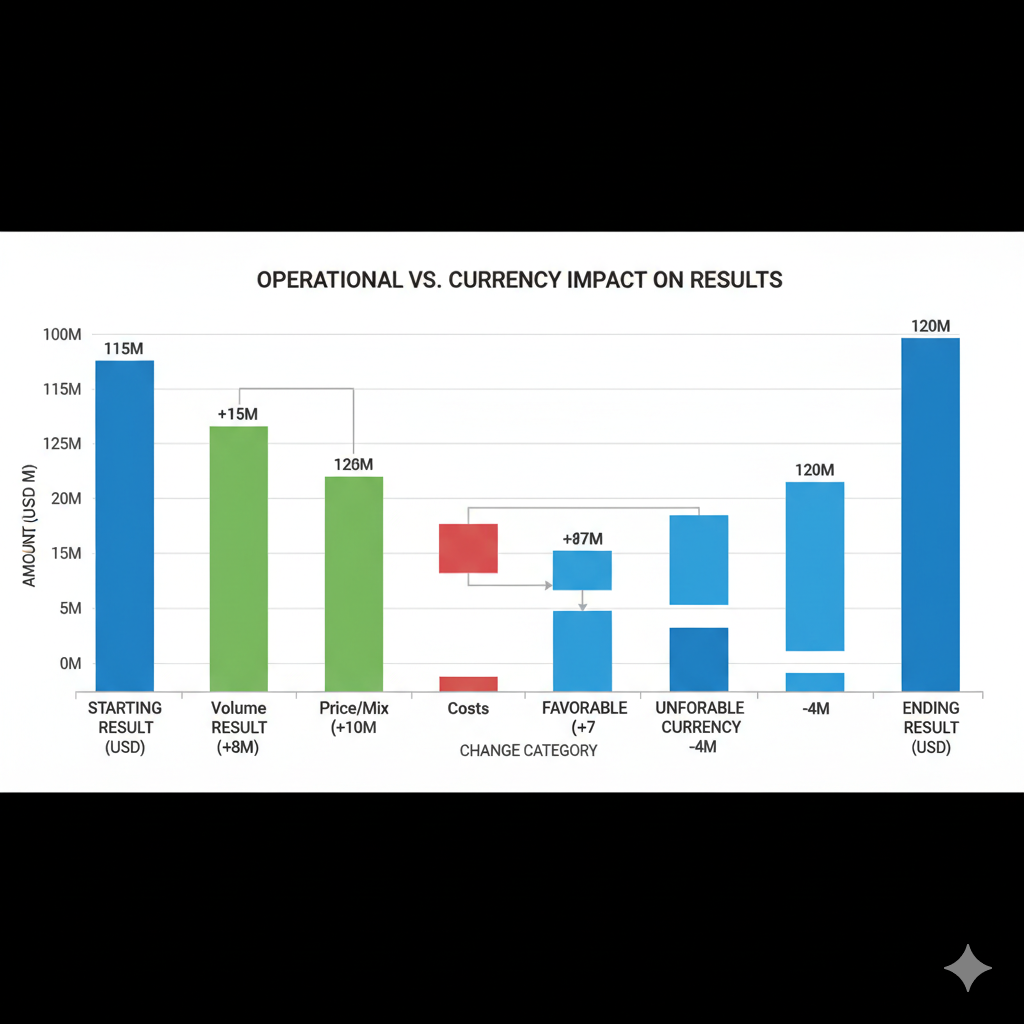
Historical rate series allow planners to normalise past results and model future scenarios using comparable data. Finance teams can separate currency movements from operational performance, improving forecast accuracy.
Outcomes
More realistic, data-driven forecasts.
Clearer visibility into FX exposure and margins.
Enhanced communication of currency impact to stakeholders.
Pro tip
Use historical rates to create “corridors” — upper and lower FX bounds — for sensitivity testing across major currency pairs.
Visual idea: a variance waterfall chart displaying operational versus currency-driven changes in results.
Use Case Four: Cross-Border Payroll Automation
The challenge
Payroll runs across multiple countries often rely on manual conversions, leading to rounding errors, disputes, and reconciliation delays.
The solution
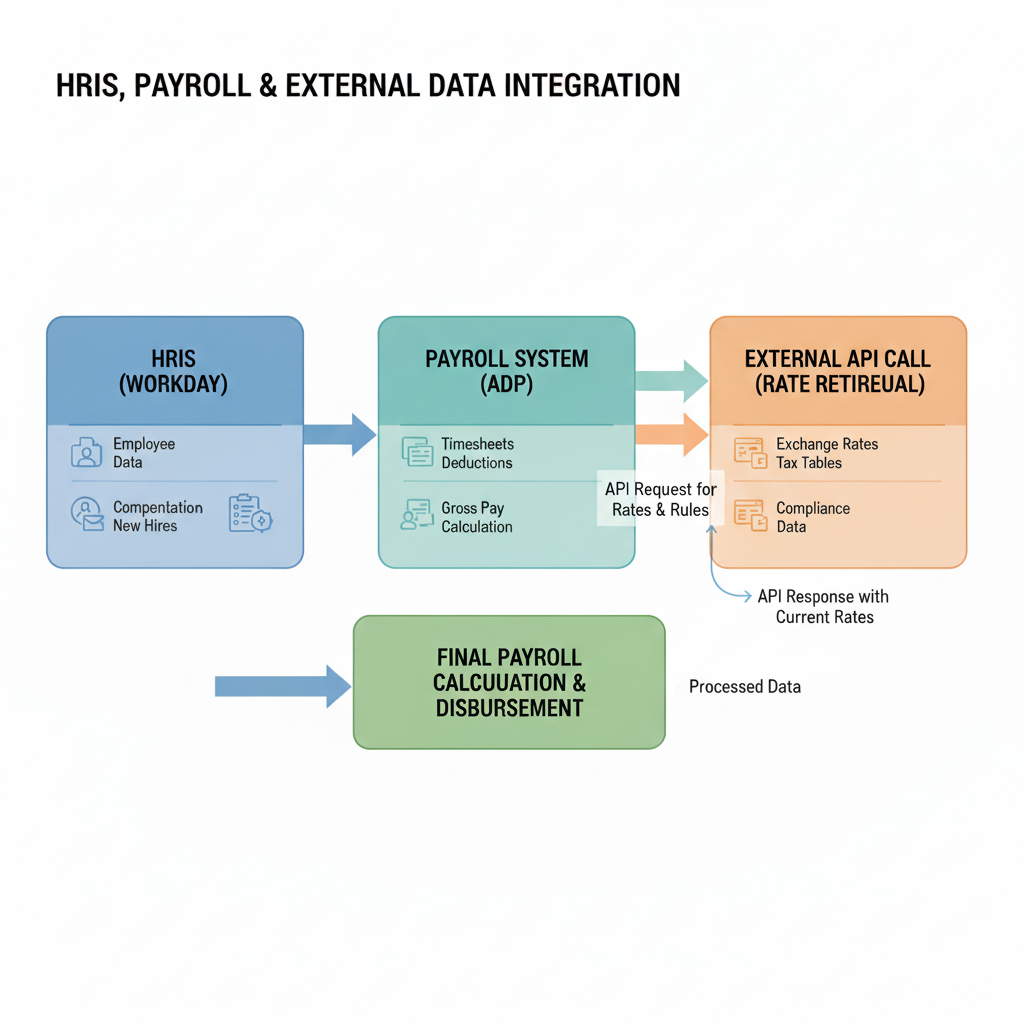
Integrating a historical exchange rate API ensures every pay period uses consistent rates based on policy (e.g. pay date or mid-month average). The same logic applies to bonuses, terminations, and retro adjustments.
Business benefits
- Smooth HR and finance alignment.
- Audit-ready documentation of pay-period rates.
- Faster, cleaner reconciliation between payroll and bank records.
Visual idea: a simplified flowchart linking HRIS, payroll systems, and the API call for rate retrieval.
Use Case Five: Multi-Currency Reconciliations
The challenge
Exchange differences complicate matching between accounts receivable, accounts payable, and intercompany ledgers.
The solution
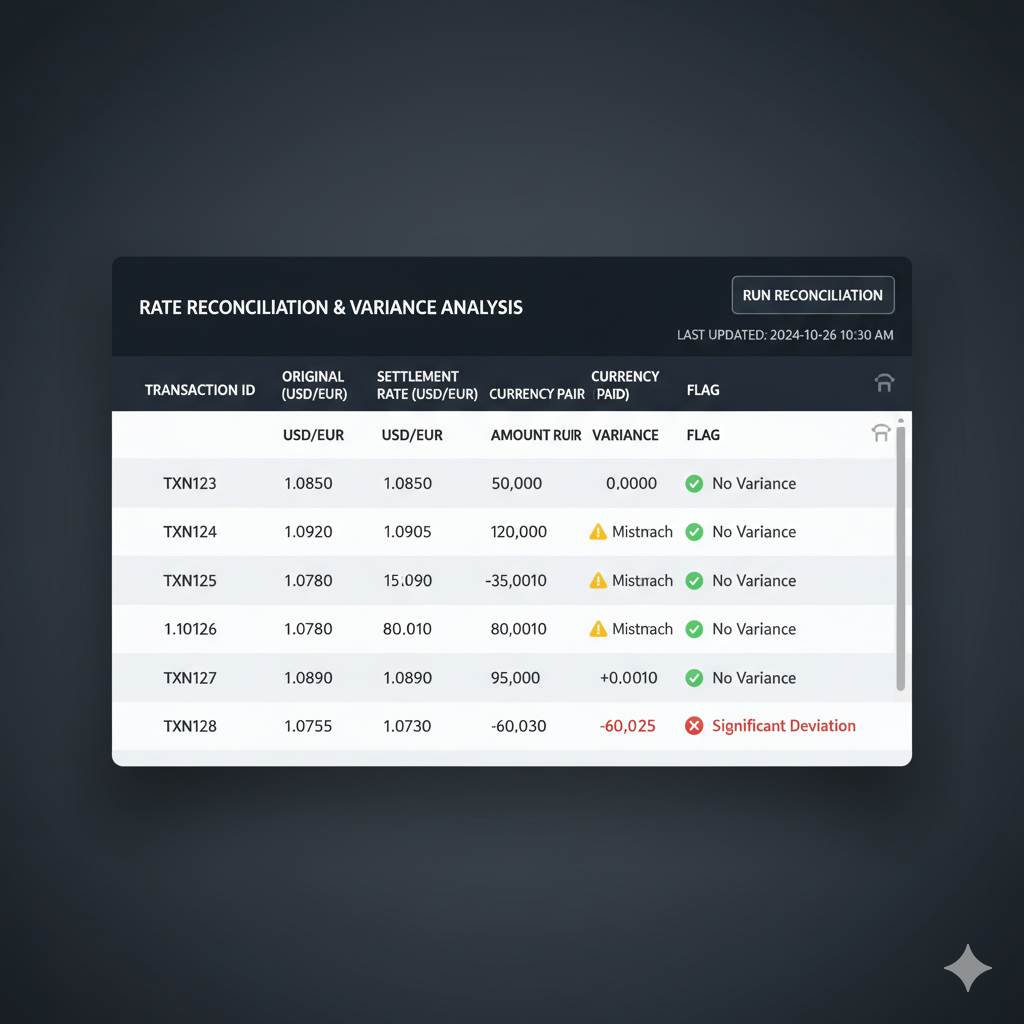
A central API allows reconciliation tools to access original, revaluation, and settlement-date rates instantly. Both sides of a transaction share identical data, making auto-matching straightforward.
Business impact
- Fewer aged items in reconciliation reports.
- Less manual intervention from finance analysts.
- Clearer variance tracking for treasury and accounting teams.
Visual idea: a reconciliation table comparing original and settlement rates with automated variance flags.
Quick Comparison:
Use Case | Benefit |
Financial reporting | Consistent currency conversions |
Tax compliance | Audit-ready historical rates |
Forecasting | Accurate FX modelling |
Payroll | Consistent pay-period conversions |
Reconciliation | Faster multi-currency matching |
How ExchangeRateData API Supports Enterprise Finance
The ExchangeRateData API is purpose-built for accuracy, uptime, and easy integration.
1. Broad coverage and historical depth
Access thousands of currency pairs with years of archived data — essential for restatements, scenario planning, and long-term trend analysis.
2. Proven stability and uptime
Enterprise workloads depend on consistency. This API delivers reliable performance for daily jobs, nightly data pipelines, and month-end processing.
3. Seamless integration
Straightforward parameters for base currency and symbols allow smooth embedding into ERP, EPM, BI, and payroll systems.
4. Transparent lineage
Every call returns time-stamped results and clear sourcing, providing confidence for auditors and regulators.
5. Ecosystem advantage
ExchangeRateData belongs to a wider APILayer suite that enhances financial operations.
Use the Fixer API for extended coverage or redundancy planning and Mailboxlayer API for data validation across employee or vendor communications.
You can find more finance-tech insights on the APILayer Blog.
Explore ExchangeRateData API
Explore currency exchange rate coverage, API endpoints, documentation, and SLA options to find the right solution for your application.
Explore API & DocumentationExplore documentation and SLA options
Top Evaluation Criteria for Historical Exchange Rate APIs
Historical depth and granularity – daily and monthly averages at minimum to support restatements and analysis.
Data provenance – transparent sourcing that withstands audit scrutiny.
Performance and uptime – measurable reliability backed by SLA.
Ease of integration – consistent response format that requires minimal custom code.
Security and governance – key-based access and detailed usage logs to meet internal control standards.
Where Visuals Strengthen Stakeholder Buy-In
Visuals turn abstract data into clarity. Suggested inserts:
A rate lifecycle diagram linking transaction, posting, and revaluation dates.
A dashboard preview showing daily FX series and conversion outcomes.
A reconciliation matrix highlighting differences resolved by consistent rate sourcing.
A forecast waterfall isolating currency effects from operational performance.
These visuals help executives grasp the impact of accurate forex data on strategic decisions.
Conclusion and Next Steps
In global finance, accuracy depends on history. Reliable historical exchange rate data ensures every conversion, forecast, and reconciliation stands up to audit and executive scrutiny.
The ExchangeRateData API delivers that reliability at enterprise scale, helping teams report faster, forecast smarter, and maintain compliance without friction.
Start using ExchangeRateData API today and explore its documentation at exchangeratesapi.io.
Additional APILayer resources
- APILayer Blog for articles on fintech APIs and automation best practices.
- Fixer API for live currency data and extended coverage.
- Mailboxlayer for verified contact data across vendor and payroll workflows.
Frequently Asked Questions
What is a historical exchange rate API?
A historical exchange rate API provides currency exchange rates for past dates, allowing businesses to perform accurate financial reporting, forecasting, payroll conversions, and audit-ready reconciliations.
How do historical exchange rate APIs improve financial reporting accuracy?
By ensuring that every conversion uses the same verified rate source for the correct date, reports stay consistent across subsidiaries and time periods.
Why is a historical exchange rate API critical for enterprise financial planning?
It provides the consistency, transparency, and repeatability finance teams need to meet audit and compliance expectations while forecasting accurately.
Can historical rate data improve forecasting and budgeting?
Yes. Consistent historical series eliminate currency noise and support reliable scenario modelling.
How does an API help automate cross-border payroll?
By standardising which rate applies to each pay period, eliminating manual steps, and documenting calculations for compliance.
What distinguishes the ExchangeRateData API from other currency APIs?
Its reliability, transparent data sourcing, and easy integration within the APILayer ecosystem — making it ideal for enterprise-scale financial workflows.
