

Your AI agent doesn’t read documentation. It doesn’t “figure out” a weird response format. If the API returns inconsistent JSON, your agent fails silently, runs up token costs retrying, and surfaces the bug days later in production logs nobody was watching. Picking APIs for agents is a fundamentally different problem than picking APIs for human-driven apps.
You’re not buying a developer experience anymore. You’re buying machine-readable predictability at volume. The criteria that mattered in 2020 (good docs, decent SDKs, reasonable uptime) are table stakes now. What actually breaks production agent systems is something else: tail latencies, fields that vanish on edge cases, rate limits that throttle mid-loop, and cost curves that explode the moment your agent fleet scales past pilot.
This post gives you a 7-criterion evaluation framework you can apply to any API your agents will call. Each criterion is scored 1 to 5, weighted, and anchored to a real example from the APILayer. Before applying the rubric, it helps to understand why standard API selection breaks down when an agent is the consumer.
Table of Contents
Key Takeaways
- Agents need different API criteria than humans: high call volume, tail-latency sensitivity, and no tolerance for ambiguity.
- Score every API on 7 weighted criteria: JSON quality, P95 latency, MCP-readiness, rate limits, determinism, cost, and observability.
- JSON schema consistency is the highest-weighted criterion (20%) because schema drift fails agents silently.
- Target P95 under 400ms for synchronous agent loops; anything above 3s forces an async rewrite.
- Test on free tiers first; IPstack scored 4.45, Marketstack 3.80, and Aviationstack 3.15 on a 300K-calls/month workload.
Why Agent-to-API Is a Different Buying Decision
A human integrating an API can adapt. They notice a missing field, read the docs, ship a workaround. An agent can’t. It calls a tool, parses JSON, and either gets a deterministic answer or hallucinates one. There is no third option.
Three things change when an autonomous agent is the consumer:
Volume scales 10 to 100x. A web app might call a geo-IP API once per session. An agent enriching 50,000 leads calls it 50,000 times in an afternoon, then loops back on retries. A 1,000-call/month plan disappears in an hour.
Reasoning chains block on tail latency. When an agent is mid-chain-of-thought waiting on a synchronous API call, the entire reasoning step blocks. Average latency lies. P95 and P99 determine whether your agent feels usable or broken.
Ambiguity becomes failure. A human sees null and infers context. An agent treats null, “”, missing fields, and “N/A” as four different signals, writes four code paths, and one eventually throws. Schema drift is catastrophic.
These three forces invalidate most legacy API rubrics. The framework below is built around them, starting with the criterion that breaks more agents than any other.
The 7-Criterion to Choose an API for AI Agents
Score each criterion on a 1 to 5 scale, multiply by the weight, and sum. The weights below are starting points, tune them to your stack. (If your agent is fully async, drop the latency weight. If you’re price-sensitive, raise the cost weight.)
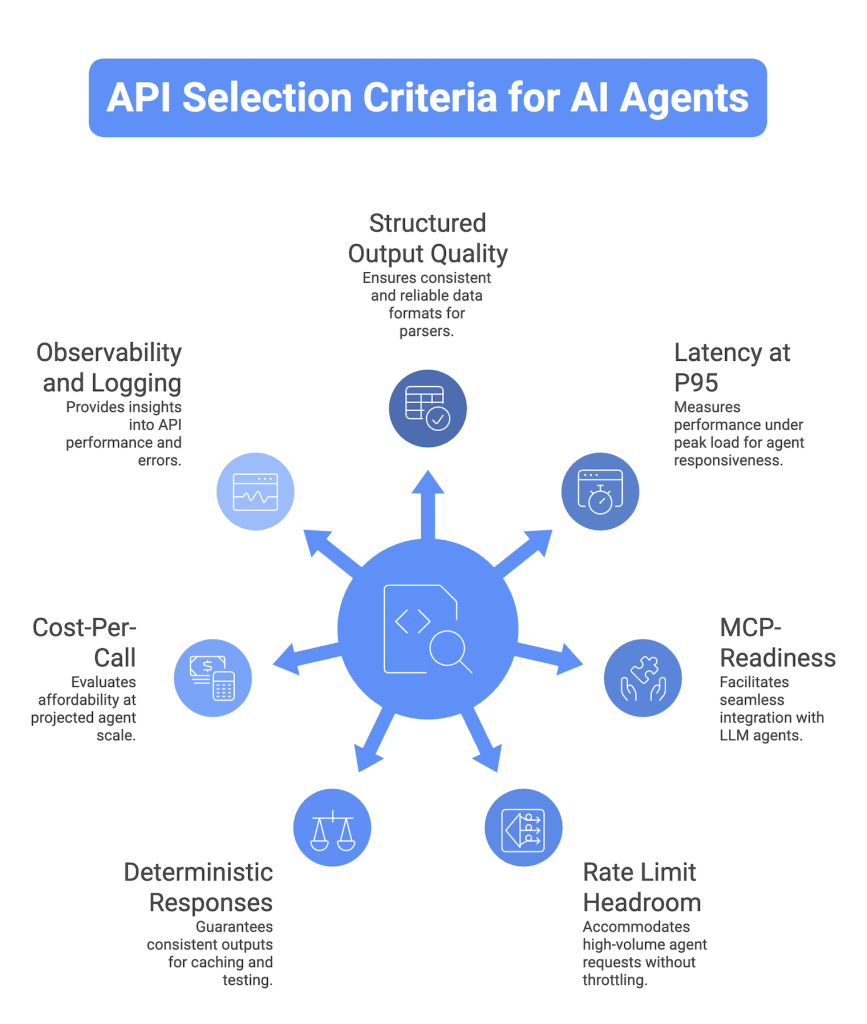
1. Structured/JSON Output Quality (Weight: 20%)
The single most important criterion, and the one most often skipped. Score by sending 50 to 100 real requests across edge cases and checking three things:
- Does the schema stay stable, or do fields disappear when data is missing?
- Are nulls represented consistently (always null, never sometimes “”, sometimes “N/A”, sometimes absent)?
- Are nested objects always present, even when empty?
IPstack is a strong reference for what a 5 looks like. Every response carries the same top-level keys (ip, type, country_code, latitude, location, time_zone, currency, connection), regardless of which IP you query. Even when a sub-value is unknown, the parent object is present. Your parser writes once, works always.
Compare that with APIs that return { “data”: […] } on success and { “error”: “…” } on failure with no data key. Every call site needs branch logic, and every branch is a future bug. Once your parser is stable, the next reliability question is whether responses come back fast enough to keep the agent loop alive.
2. Latency at P95 (Weight: 15%)
Average latency is marketing. P95 latency is engineering. If your agent loop calls the API five times sequentially, a 2-second P95 means a 10-second floor on that reasoning step (worst case much higher).
For synchronous agent loops, target P95 under 400ms. For background enrichment, under 1.5s is acceptable. Anything above 3s at P95 forces an async redesign you didn’t budget.
Marketstack is a useful test case. Financial agents calling end-of-day endpoints across symbols can be heavy. Run 200 sequential calls and measure P95 yourself, vendor averages won’t tell you what your agent will feel. Speed alone doesn’t make an API agent-ready, though. The integration shape matters just as much.
3. MCP-Readiness (Weight: 15%)
Model Context Protocol (MCP) is becoming the standard way to expose tools to LLM agents. An MCP-ready API can be wrapped as a tool the agent calls natively, without 200 lines of glue code per endpoint.
Score a 5 if there’s an official or community MCP server for the API. A 4 if the API has a single well-documented OpenAPI spec that auto-generates a clean MCP wrapper. A 1 if responses contain deeply nested arrays of optional fields with no schema, every wrapper becomes a custom project.
Aviationstack illustrates the nesting challenge. Its flights endpoint returns objects with departure, arrival, airline, flight, aircraft, and live sub-objects, each with optional fields like gate, terminal, baggage that are frequently null.
Wrapping this for MCP means deciding upfront how the agent should handle every nullable path, otherwise the LLM sees inconsistent tool outputs and starts fabricating field values.
Once a clean wrapper exists, the next question is whether the API will let the agent actually call it as often as the workflow demands.
4. Rate Limit Headroom for Agent Loops (Weight: 15%)
Agents don’t make 1 call per task. They make 5 to 50 in retry, refinement, and verification loops. A “1 request per second” cap is fine for a dashboard, fatal for an agent.
Look at three things: requests-per-second ceiling, monthly quota at projected scale, and burst tolerance. Aviationstack’s plans go from 100 free monthly requests up to scale tiers; production agent fleets need the higher ones.
Marketstack documents an overall API limit of 5 requests/second, with stricter limits (1 call/min) on certain Professional-tier endpoints like real-time stock prices and commodities.
If your portfolio agent fans out across 30 tickers in parallel, map that ceiling before your agent hits it. Throughput headroom only matters, however, if every call returns the same answer the previous one did.
5. Deterministic vs. Probabilistic Responses (Weight: 10%)
Same input, same output. Always.
This sounds obvious, but many APIs have soft non-determinism: rounding drift on numeric fields, timestamp recalculation on every call, ordering changes in array responses, “current_time” embedded in cacheable lookups. Each one breaks downstream caching, makes tests flaky, and corrupts agent memory.
IPstack scores high here. Look up 134.201.250.155 today and tomorrow, the geo, ISP, and connection data are identical. Aviationstack, by design, is non-deterministic on real-time flight data (it updates every 30 to 60 seconds).
Correct for the use case, but agents must either tolerate drift or pin to historical endpoints for reproducible runs. Stable schemas and stable answers keep the system functional; cost is what determines whether it stays viable at scale.
6. Cost-Per-Call at Agent Scale (Weight: 15%)
Pricing pages are written for human-driven traffic. Agent traffic breaks that model.
Run the math at 300,000 calls/month and again at 3,000,000. Marketstack’s tiers run Free at 100/mo, Basic at 10,000/mo, Professional at 100,000/mo, and Business at 500,000/mo, with Enterprise custom beyond. A 300,000-call workload sits awkwardly between tiers, and overage fees apply once you exceed quota.
What to score: per-call cost at projected volume; overage rates; whether tier jumps are linear or step-function expensive; whether bulk endpoints exist (IPstack offers Bulk Lookup on Professional+, collapsing N agent calls into 1 billed call).
A 5 means cost stays linear from 100K to 10M calls. A 1 means a bad surprise on next month’s invoice. The seventh criterion covers what happens when something does go wrong.
7. Observability and Logging (Weight: 10%)
When an agent loop produces wrong outputs in production, you need to trace which tool call returned what, when. Score by checking: Does the API return a request ID? Does the dashboard show per-endpoint usage and latency? Are errors structured (code + type + message) or just HTTP 500s?
IPstack, Marketstack, and Aviationstack all return structured error objects with numeric codes (e.g., 104 for “monthly request volume exceeded”) and provide dashboards with quota tracking and threshold notifications. That’s a 4.
A 5 would add per-request IDs in headers and webhook-based usage alerting. Plan to instrument your tool layer with your own request IDs and span tracing regardless. With all seven criteria defined, the next step is seeing how they look against real responses.
Working Examples: Three APIs Through an Agent’s Eyes
The same scoring framework produces different shapes of strengths and weaknesses for different APIs. Here are three real calls (IPstack, Marketstack, Aviationstack) with annotations on what an agent’s parser actually cares about and where each could break.
IPstack: The Flat-Schema Reference
					import requests

ACCESS_KEY = "YOUR_API_KEY"
ip = "134.201.250.155"

response = requests.get(
    f"https://api.ipstack.com/{ip}",
    params={"access_key": ACCESS_KEY},
    timeout=2.0  # Tight timeout: agent loops cannot block
)

data = response.json()
Response:
					{
  "ip": "134.201.250.155",
  "type": "ipv4",
  "continent_code": "NA",
  "continent_name": "North America",
  "country_code": "US",
  "country_name": "United States",
  "region_code": "CA",
  "region_name": "California",
  "city": "Los Angeles",
  "zip": "90013",
  "latitude": 34.0655,
  "longitude": -118.2405,
  "location": {
    "geoname_id": 5368361,
    "capital": "Washington D.C.",
    "languages": [
      { "code": "en", "name": "English", "native": "English" }
    ],
    "country_flag": "https://assets.ipstack.com/images/assets/flags_svg/us.svg",
    "country_flag_emoji": "🇺🇸",
    "calling_code": "1",
    "is_eu": false
  },
  "time_zone": {
    "id": "America/Los_Angeles",
    "current_time": "2024-06-14T01:45:35-07:00",
    "gmt_offset": -25200,
    "code": "PDT",
    "is_daylight_saving": true
  },
  "currency": { "code": "USD", "name": "US Dollar", "symbol": "$" },
  "connection": { "asn": 25876, "isp": "Los Angeles Department of Water & Power" }
}
What an agent parser cares about:
- country_code, latitude, longitude are the high-value scalars. Present on every successful response. Safe to require.
- location.languages is an array of objects. Handle the empty-array case (some IPs have no language mapping) without throwing.
- time_zone.current_time is non-deterministic, it changes every call. Cache by IP, not by full response, or your cache hit rate collapses.
- connection.isp can be null on edge cases (private IPs, certain reserved blocks). Tolerate null, don’t assume a string.
The schema is flat and predictable. That’s the IPstack pattern. Marketstack adds an envelope on top of the data, which changes how an agent should parse it.
Marketstack: The Pagination Envelope
					import requests

ACCESS_KEY = "YOUR_API_KEY"

response = requests.get(
    "https://api.marketstack.com/v2/eod",
    params={
        "access_key": ACCESS_KEY,
        "symbols": "AAPL",
        "limit": 1
    },
    timeout=3.0  # Wider window: financial endpoints are heavier
)

payload = response.json()
prices = payload["data"]
Response:
					{
  "pagination": { "limit": 100, "offset": 0, "count": 22, "total": 22 },
  "data": [
    {
      "open": 228.46,
      "high": 229.52,
      "low": 227.30,
      "close": 227.79,
      "volume": 34025967.0,
      "adj_open": 228.46,
      "adj_high": 229.52,
      "adj_low": 227.30,
      "adj_close": 227.79,
      "adj_volume": 34025967.0,
      "split_factor": 1.0,
      "dividend": 0.0,
      "name": "Apple Inc",
      "exchange_code": "NASDAQ",
      "asset_type": "Stock",
      "price_currency": "usd",
      "symbol": "AAPL",
      "exchange": "XNAS",
      "date": "2024-09-27T00:00:00+0000"
    }
  ]
}
What an agent parser cares about:
pagination + data is a two-key envelope. The agent must always handle the data array, even when it has one element. Don’t index [0] blindly, check pagination.count first.
adj_close vs close: agents doing portfolio math should use the adj_* (split- and dividend-adjusted) fields. Mixing the two corrupts return calculations silently.
price_currency: “usd” is lowercase. Agents comparing against ISO 4217 codes (always uppercase) need to normalize on ingest, otherwise equality checks fail.
split_factor defaults to 1.0, dividend to 0.0, never null. That’s a positive: deterministic numeric defaults remove a null-handling branch.
date uses +0000 without a colon. Most ISO-8601 parsers accept it, but Python’s datetime.fromisoformat() before 3.11 doesn’t. Mismatched parser versions across your agent fleet will create silent bugs.
Marketstack is consistent inside the envelope but requires the agent to traverse one extra level. Aviationstack’s nesting goes further still, into multiple sibling sub-objects with frequent nulls.
Aviationstack: The Nullable Nest
					import requests

ACCESS_KEY = "YOUR_API_KEY"

response = requests.get(
    "https://api.aviationstack.com/v1/flights",
    params={
        "access_key": ACCESS_KEY,
        "flight_iata": "AA1004",
        "limit": 1
    },
    timeout=3.0
)

payload = response.json()
flights = payload["data"]
Response:
{ |
What an agent parser cares about:
- live: null is the common case, not the exception. Free and Basic plans return null for the live object on most flights. Agents querying live position must check before accessing.
- arrival.gate, arrival.terminal, arrival.baggage are routinely null until the flight is close to arrival. Agent code that templates “Arriving at gate {gate}” must guard for null or render gracefully.
- Five different timestamps per leg (scheduled, estimated, actual, estimated_runway, actual_runway). Agents need explicit logic for which one represents the truth right now. A reasonable default: prefer actual if not null, else estimated, else scheduled.
- flight.codeshared: null is the common case; when set, it’s an object. The polymorphic null-or-object pattern is exactly the kind of structure that breaks naive parsers.
- The whole response is volatile. A flight active right now will have different actual_runway, delay, and live values 60 seconds from now. For agent caching, treat the full payload as cacheable for 30 to 60 seconds at most.
Across these three APIs, the same parser strategy doesn’t work, which is exactly why a weighted scoring rubric matters more than a single quality grade.
The Full Scoring Matrix
Criterion | Weight | Top of Scale | Bottom of Scale |
JSON Output Quality | 20% | Stable schema, consistent nulls, all nested objects always present | Fields disappear on edge cases, nulls inconsistent, error responses lack the data key |
P95 Latency | 15% | Under 400ms P95 globally, under 200ms regionally | Over 3s P95, frequent timeout-level outliers |
MCP-Readiness | 15% | Official MCP server or clean OpenAPI spec, wrapper-ready | No spec, deeply nested, requires custom adapter per endpoint |
Rate Limit Headroom | 15% | Generous burst tolerance, clear per-second and monthly limits, headroom at 10x projected load | Aggressive throttling, undocumented burst limits, hard to scale |
Determinism | 10% | Same input always returns same output (excluding intentional time fields) | Soft non-determinism (rounding drift, ordering changes, hidden timestamps) |
Cost at Scale | 15% | Linear pricing from 100K to 10M+ calls, bulk endpoints available | Step-function pricing, expensive overages, no bulk option |
Observability | 10% | Per-request IDs, dashboard usage analytics, structured error codes, threshold alerts | HTTP status only, no request IDs, no dashboard visibility |
How IPstack, Marketstack, and Aviationstack Score
Scored from public documentation and the agent workload assumptions used above (300K calls/month, synchronous tool use). Tune for your own context.
Criterion | Weight | IPstack | Marketstack | Aviationstack |
JSON Output Quality | 20% | 5 | 4 | 3 |
P95 Latency | 15% | 5 | 4 | 4 |
MCP-Readiness | 15% | 4 | 4 | 3 |
Rate Limit Headroom | 15% | 4 | 3 | 3 |
Determinism | 10% | 5 | 5 | 2 (real-time data) |
Cost at Scale | 15% | 4 | 3 | 3 |
Observability | 10% | 4 | 4 | 4 |
Weighted Total | 4.45 | 3.80 | 3.15 |
The reading: IPstack is the strongest fit for agent integration of the three, primarily because of its flat consistent schema and stable lookups. Marketstack is solid but has tier and rate-limit edges to plan around, and the pagination envelope adds one extra parsing step. Aviationstack scores lower not because it’s a worse API but because real-time flight data is inherently non-deterministic and its nested response shape adds wrapper complexity. None of these scores are absolute. Weight the rubric for your use case. Even with the right scores, this is only one half of the decision.
Where This Fits in Your Procurement Process
This 7-criterion rubric is the technical evaluation layer. It tells you whether the API will work for your agents at the system level. It doesn’t cover vendor reliability, SLA terms, data licensing, or support quality.
Pair this technical score with a broader API procurement checklist that covers business and vendor-risk dimensions. The technical rubric tells you which API can survive contact with an autonomous agent. The procurement layer tells you whether to sign with the vendor at all. Use both. The fastest way to validate any of this is to run the rubric against real APIs yourself.
Start Building with APILayer
Access a powerful ecosystem of APIs for IP intelligence, finance, search, geolocation, validation, and more. Build faster with reliable APIs trusted by developers worldwide.
Explore APILayer APIsDeveloper-friendly documentation
Run Your Own Evaluation
IPstack, Marketstack, and Aviationstack all offer free tiers on the APILayer, enough to run your own evaluation against this rubric before committing. Pull 100 sample responses, measure P95 yourself, score JSON consistency manually, and project costs at your real volume.
Start your API evaluation at apilayer.com.
Documentation: IPstack · Marketstack · Aviationstack
Frequently Asked Questions
1). What is the best API for AI agents in 2026?
The best API for an AI agent depends on the workload, but APIs with flat consistent JSON schemas, sub-400ms P95 latency, and clear rate-limit headroom score highest on agent-specific rubrics. On the 7-criterion framework above, IPstack scored 4.45 out of 5, ahead of Marketstack (3.80) and Aviationstack (3.15) for a generic enrichment workload.
2). How is choosing an API for AI agents different from choosing one for traditional apps?
Agents call APIs 10 to 100x more often than human-driven apps, cannot interpret ambiguous responses, and block their entire reasoning chain on slow synchronous calls. That makes JSON consistency, P95 latency, and rate-limit headroom matter far more than developer experience, SDKs, or documentation polish.
3). What is MCP-readiness and why does it matter for AI agents?
MCP-readiness measures how easily an API can be wrapped as a tool for an LLM agent under the Model Context Protocol standard. APIs with clean OpenAPI specs or official MCP servers can be exposed to agents with minimal glue code, while deeply nested responses with optional fields force you to write a custom adapter per endpoint.
4). What latency is acceptable for an AI agent calling an API?
For synchronous agent loops, P95 latency should stay under 400ms; for background enrichment, under 1.5 seconds is acceptable. Anything above 3 seconds at P95 forces an async redesign because each call blocks the entire reasoning chain.
5). How many API calls does an AI agent make per task?
A single agent task typically makes 5 to 50 API calls across retry, refinement, and verification loops, not just one. This is why rate-limit headroom is critical: a “1 request per second” cap that suits a dashboard will throttle an agent mid-workflow.
6). What does an API cost at AI agent scale?
At 300,000 calls per month (a modest agent system), most consumer APIs sit awkwardly between published tiers and trigger overage fees. Marketstack’s tiers run Free at 100/mo, Basic at 10,000/mo, Professional at 100,000/mo, and Business at 500,000/mo, so an agent workload often needs the next tier up plus overage budget.
7). Why do AI agents need deterministic API responses?
Agents cache prior responses, use them as context for later reasoning, and assume the same input returns the same output. Soft non-determinism (rounding drift, timestamp recalculation, ordering changes in arrays) breaks caching, makes tests flaky, and silently corrupts agent memory.
8). Can any REST API be exposed to an AI agent through MCP?
Technically yes, but the integration quality depends entirely on the response shape. APIs with flat consistent schemas (like IPstack) wrap cleanly, while APIs with deeply nested optional fields (like Aviationstack’s flights endpoint with its nullable live, gate, terminal, and baggage fields) need a custom adapter that maps every nullable path before the agent can call them reliably.
9). What is the difference between average latency and P95 latency for APIs?
Average latency is the mean response time across all calls, while P95 latency is the threshold under which 95% of calls complete (meaning 1 in 20 calls is slower). For AI agents that block on synchronous calls, P95 is the only number that matters because the slowest 5% determine whether the agent feels usable.
