

Today we’re launching the APILayer suite: 24 APIs accessible under one account, one API key, and one dashboard. You subscribe once, add the APIs you need, and run all of them from a single place.
We’ve started with nine of our most popular APIs, and we’re bringing the rest of our catalog onto the suite across the year.
Live today:
IPstack: IP geolocation
Aviationstack: real-time flight data
Marketstack: stock market data
Mailboxlayer: email verification
Serpstack: Google search results
Countrylayer: country data
Scrapestack: web scraping
Positionstack: geocoding
Mediastack: news data
Table of Contents
Why we built a suite
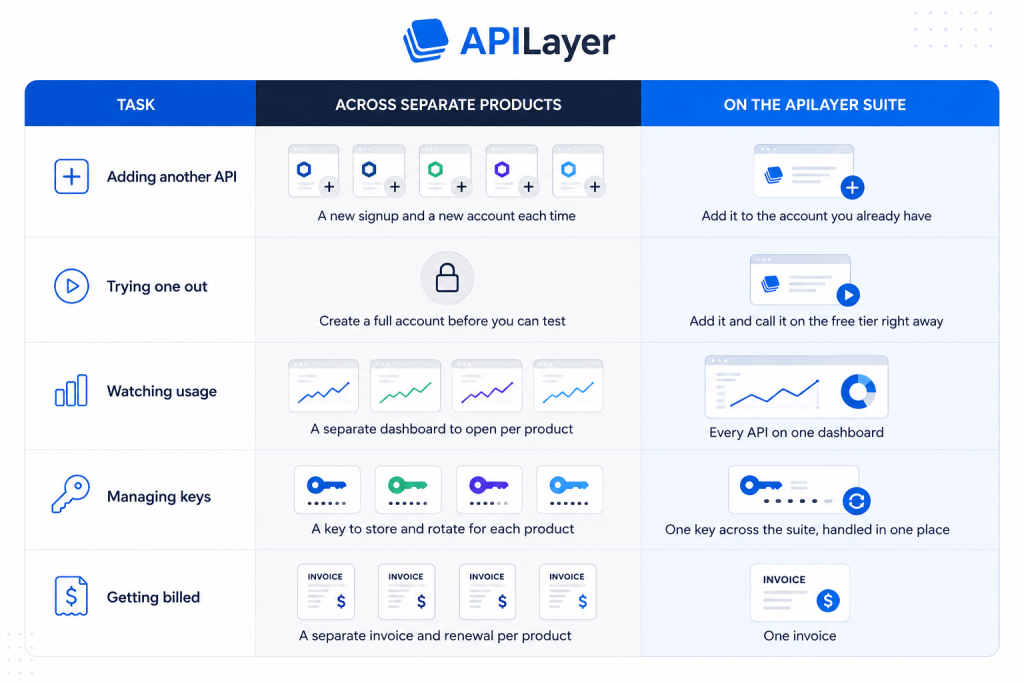
We’ve spent years building and operating more than 24 APIs, used by developers and enterprises across finance, travel, security, and media, from early startups to large teams. That gave us a clear view of where the real cost of using APIs lives, and it was never the integration. Setting up one more API is an afternoon’s work. What accumulates is everything around it.
The same questions kept coming up from customers running several of our APIs at once:
Why do I need a separate account for every API I use?
Where do I go to see usage across all of them in one place?
Why is each product billed separately, on its own invoice?
How do I keep a growing list of API keys organized?
That is API sprawl. Each piece is small on its own. Together they are the operational weight that slows teams down, and it grows with every vendor you come to depend on.
Few companies see API sprawl from as close up as we do. We operate more than 24 APIs and work with the developers and enterprises using them every day, so the operational weight is something we understand firsthand. The suite is our answer to it.
How It Works
Getting onto the suite takes a few minutes.
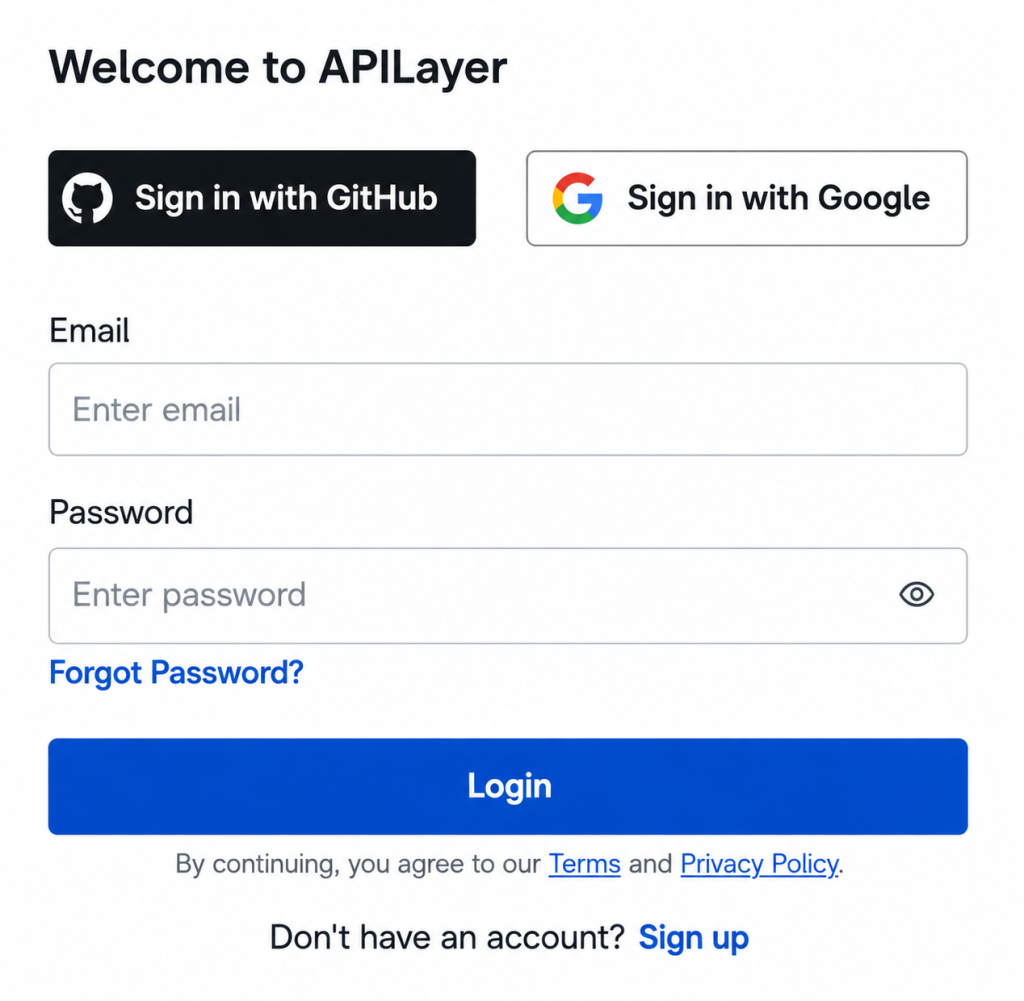
1. Create your account. One signup on apilayer.com gives you an APILayer account and access to the full suite, free to start.
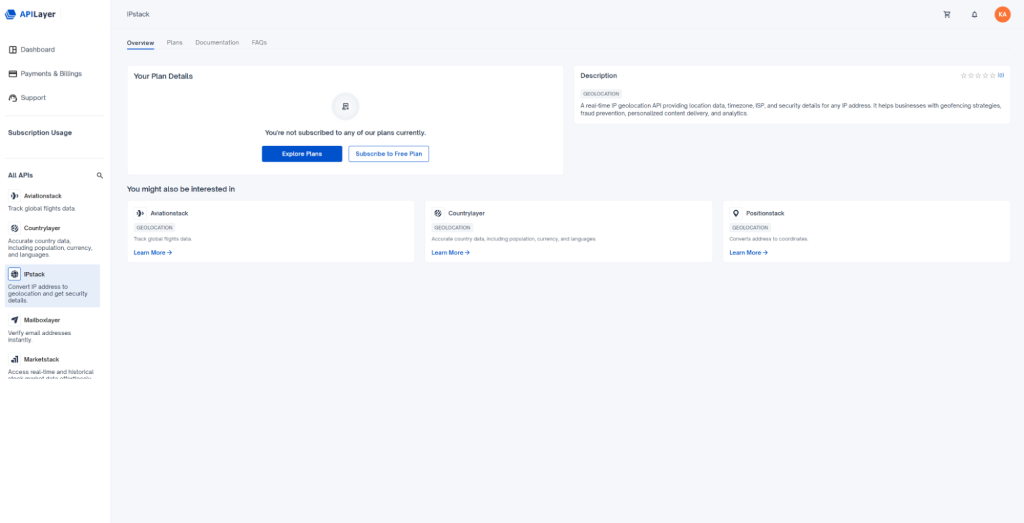
2. Add the APIs you need. Browse the catalog and add any API to your account. There is nothing new to wire up. It is available the moment you add it.
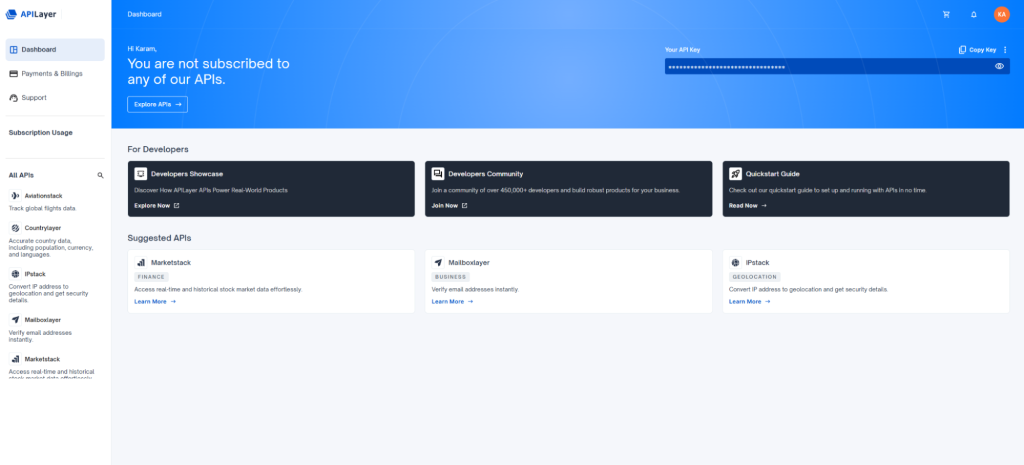
3. Call everything with one key. Every API on your account answers to the same key found in your dashboard.

4. Manage it all in one place. Usage, keys, and billing for every API live on one dashboard, on one invoice. Add another API and it appears alongside the rest, not in a separate account you have to remember.
One set of plans, every API
Every product used to be sold its own way, so each one was a new pricing page to decode. Plans are now standardized across the whole suite: Starter, Professional, and Enterprise. Prices differ by API,, but the shape is identical everywhere. You learn how our plans work once, and that carries to every product you add.
Your existing API keeps working
If you already use one of our APIs, nothing changes today. Your current key, dashboard, and docs work exactly as they do now. We’re moving existing accounts onto the suite gradually over the year, and we’ll tell you before anything changes for you.
If you’d like to start using the suite now, you’re welcome to. You’ll create a fresh account on apilayer.com, since sign-ins from our individual API products don’t carry over yet.
Get started
Create your account at apilayer.com and start building on any of the live APIs in minutes. Every API includes a free tier, no credit card required.
One account. One key. Every API.
Get Your Free API Keys!
Join thousands of developers using APILayer to power their applications with reliable APIs!
Get Your Free API Keys!100 Requests Free!
Frequently asked questions
Do I need a separate account and API key for each API?
No. One APILayer account gives you access to the whole suite, and a single API key works across every API you add. There is nothing new to set up when you add another product.
Which APIs are available on the suite today?
We launched with nine of our most popular APIs, including IPstack, Marketstack, Aviationstack, and Mailboxlayer. We’re bringing the rest of our catalog onto the suite across the year.
Is there a free tier, and how much does it cost?
Every API includes a free tier you can build against, with no credit card required. Paid plans are standardized across the suite as Starter, Professional, and Enterprise, with prices set per API.
