


Every second, billions of dollars move across currency pairs and crypto markets. But the mechanics behind these movements are fundamentally different. Traditional fiat currencies like USD and EUR operate within structured markets governed by central banks, while cryptocurrencies like Bitcoin and Ethereum trade 24/7/365 across decentralized exchanges with no central authority.
For developers, fintech founders, and data teams, tracking both simultaneously creates a friction point. You end up managing multiple API subscriptions, parsing different JSON structures, and reconciling mismatched timestamps. This is where a unified approach becomes essential.
Table of Contents
What You Will Learn
- How traditional fiat exchange rates are determined and why they move
- The mechanisms driving cryptocurrency price discovery across decentralized markets
- Why crypto rates behave differently from forex rates
- The technical challenges of integrating both data types
- How a single API can deliver both fiat and crypto rates in one unified format
How Traditional Fiat Exchange Rates Work
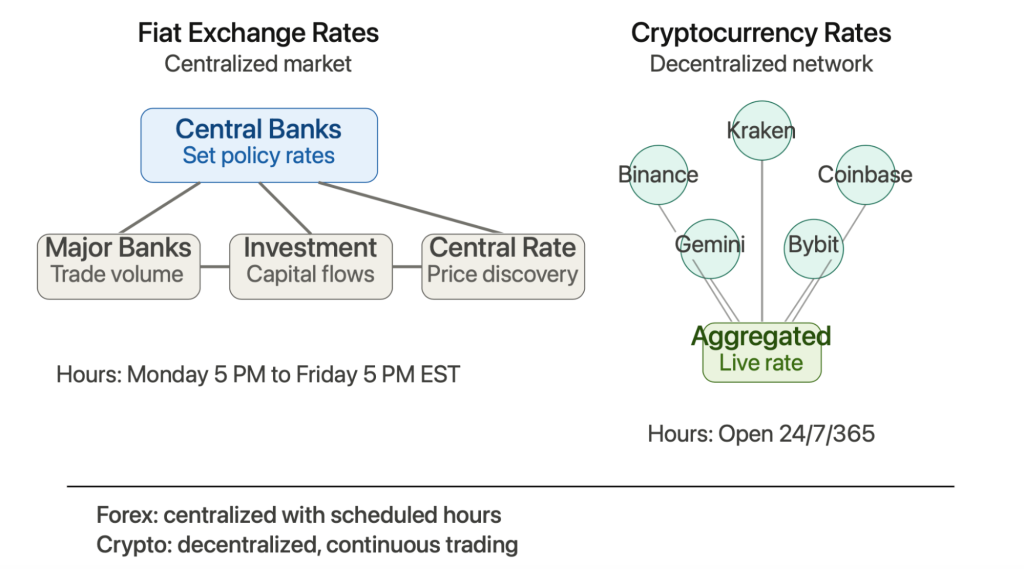
Fiat currencies operate within a structured framework. The USD/EUR exchange rate you see quoted is determined by the largest forex market in the world, where banks, investment firms, and central banks trade trillions of dollars daily.
Supply and Demand in Forex Markets
At its core, every exchange rate reflects supply and demand. If American investors want to buy European assets, they need euros. This increased demand pushes the EUR higher against the USD. Conversely, if the Federal Reserve signals interest rate increases, international investors might want to hold more dollars, shifting the rate downward.
Central Bank Influence
Central banks like the ECB and Federal Reserve don’t control rates directly through price fixing. Instead, they influence them through monetary policy decisions. When the Fed raises interest rates, foreign investors gain more return on dollar holdings, increasing demand. When geopolitical tensions spike, flight to safety mechanisms push currencies like the Swiss franc higher.
Market Hours and Liquidity
Forex trading operates on a schedule: London opens at 8 AM GMT, New York at 1 PM GMT, and Tokyo at 10 PM GMT. This creates a continuous 24/5 market with overlapping sessions. During off hours and weekends, the market thins considerably, making large moves less likely. This predictable rhythm is one reason forex remains the most stable major currency market.
How Cryptocurrency Exchange Rates Work
Cryptocurrency prices operate under completely different rules. Bitcoin and Ethereum are traded on hundreds of decentralized and centralized exchanges simultaneously, with no single source of truth.
Distributed Price Discovery
Unlike forex, where major banks set the benchmark, crypto prices emerge from millions of transactions happening in parallel across exchanges like Coinbase, Binance, Kraken, and smaller platforms. The BTC price you see represents an aggregation of these simultaneous trades. If Binance trades BTC at a slightly different price than Kraken, arbitrage traders exploit this gap, pushing prices back toward parity.
Supply Scarcity and Community Sentiment
Bitcoin’s supply is hard-capped at 21 million coins. Ethereum’s supply can grow but is now deflationary. This fixed supply creates a different dynamic than fiat, where central banks can print currency. Any major news, regulatory shift, or technological breakthrough can cause dramatic repricing within minutes because of the marginal price mechanism: a single large buy order can move the price significantly in low-liquidity moments.
24/7/365 Market Operations
Cryptocurrency markets never close. There is no Asian close or American open. A market shock at 3 AM on a Sunday still triggers instant repricing. This round-the-clock operation means crypto rates can exhibit high volatility at any time.
Key Differences: Fiat vs. Crypto at a Glance
Characteristic | Fiat (Forex) | Cryptocurrency |
Market Hours | 24/5 (Sunday 5 PM to Friday 5 PM EST) | 24/7/365 no breaks |
Price Authority | Central banks influence via policy | Decentralized, no central authority |
Volatility | Typically 0.5% to 2% daily swings | Often 5% to 50% daily swings |
Primary Drivers | Geopolitics, interest rates, trade flows | Adoption, sentiment, technical catalysts |
Liquidity | Extremely deep at major pairs | Highly variable depending on coin |
Spreads | Tight on major pairs (0.5 to 2 pips) | Variable (0.1% to 5%+ on smaller tokens) |
The Technical Challenge: Managing Two Data Streams
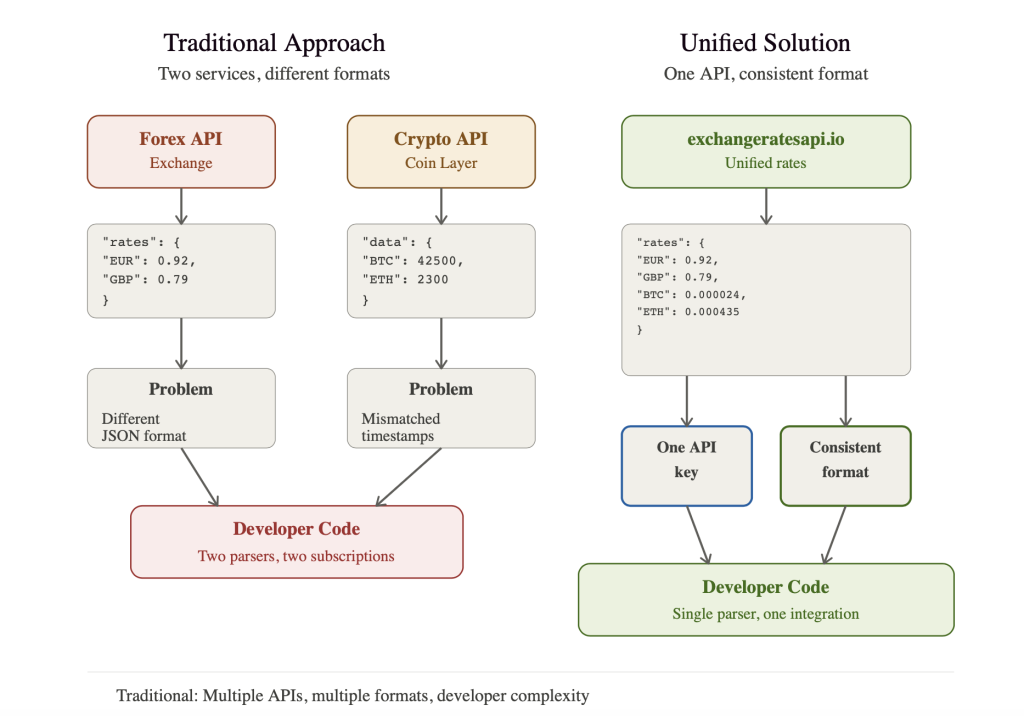
In a real-world fintech scenario, you might need to track both fiat currency conversions and crypto holdings. This creates several integration headaches:
Problem 1: Multiple API Subscriptions
Traditionally, you subscribe to one API for forex (like Open Exchange Rates) and another for crypto (like CoinGecko). This means separate authentication, separate documentation, and separate support channels.
Problem 2: Inconsistent JSON Structures
Forex APIs often return rates in one structure, crypto APIs in another. A forex response might look like this:
					{
  "base": "USD",
  "date": "2024-03-18",
  "rates": {
    "EUR": 0.92,
    "GBP": 0.79
  }
}
Crypto APIs might return something entirely different:
					const express = require('express')
const app = express()
const port = 3000


require('dotenv').config()
Your code needs separate parsers for each, increasing complexity and maintenance burden.
Problem 3: Timestamp Misalignment
Forex data typically updates once per day at market close. Crypto data updates in real-time. When you combine them for analysis, you’re mixing data from different time windows, leading to stale currency conversions.
Problem 4: Cost and Vendor Lock-In
Managing two vendor relationships is expensive. You pay separate monthly fees, manage separate API keys, and if one service has an outage, your entire system degrades.
The Solution: A Unified API for All Exchange Rates
This is where exchangeratesapi.io becomes powerful. It provides both traditional fiat exchange rates and cryptocurrency data through a single endpoint, with consistent JSON formatting.
One API. Two Asset Classes.
With exchangeratesapi.io, you can request fiat pairs like USD/EUR and crypto pairs like BTC/USD in the same API call:
GET /latest?base=USD&symbols=EUR,GBP,BTC,ETH
					{
  "success": true,
  "timestamp": 1710787200,
  "base": "USD",
  "date": "2024-03-18",
  "rates": {
    "EUR": 0.92,
    "GBP": 0.79,
    "BTC": 0.000024,
    "ETH": 0.000435
  }
}
Notice the consistent structure. All rates live in the same rates object, with matching timestamps. You parse once, use everywhere.
Real-Time Precision
The API updates every 15 minutes for crypto and daily for fiat, ensuring your application has current data without re-architecting your pipeline. For fintech platforms, investment apps, and payment processors, this eliminates the complexity of syncing two separate feeds.
Seamless Conversion Chains
You can now ask questions like: What is 1 Bitcoin worth in Euros? Traditionally, this required two API calls to two services. With exchangeratesapi.io, it’s a single request. Convert to USD, then USD to EUR all in the same response.
Getting Started with exchangeratesapi.io
Step 1: Sign Up and Get Your API Key
Visit the exchangeratesapi.io dashboard and create an account. You’ll receive an API key that grants access to both fiat and crypto endpoints.
Step 2: Make Your First Request
curl “https://api.exchangeratesapi.io/latest?access_key=YOUR_API_KEY&base=USD&symbols=EUR,BTC”
Step 3: Parse and Use the Response
					const response = await fetch(
  `https://api.exchangeratesapi.io/latest?access_key=YOUR_KEY&base=USD&symbols=EUR,BTC`
);
const data = await response.json();

const eurRate = data.rates.EUR;
const btcRate = data.rates.BTC;
const btcInEur = 1 / btcRate * eurRate;

console.log(`1 BTC is worth ${btcInEur} EUR`);
Step 4: Implement Caching
Since crypto rates update every 15 minutes and fiat rates daily, implement a cache with appropriate TTLs. Store the response and refresh only when your cache expires. This reduces API calls and improves response time.
Real-World Use Case: A Cross-Border Payment Platform
Imagine you run a payment platform that lets European users send money to crypto investors in the US. Your system needs to:
- Accept EUR from the user
- Convert EUR to USD at the live rate
- Allow the recipient to receive funds in BTC or USD
- Provide transparent, real-time pricing
Without a unified API, you’d juggle three different subscriptions and handle reconciliation overhead. With exchangeratesapi.io, you get one API call that provides all three conversion rates. Your server hits the endpoint, receives all rates simultaneously, and you can offer the user multiple payout options with accurate pricing.
Frequently Asked Questions
1). How often are rates updated?
Fiat rates update daily at market close. Crypto rates update every 15 minutes to capture the latest price action across exchanges.
2). Can I request historical rates?
Yes. Exchangeratesapi.io offers historical endpoints for backtesting trading strategies or analyzing past conversion scenarios.
3). What cryptocurrencies are supported?
The API supports major cryptocurrencies including Bitcoin (BTC), Ethereum (ETH), Litecoin (LTC), Ripple (XRP), and many others.
4). How do I handle rate limits?
Standard plans include sufficient request quotas for most applications. Implement caching to stay well below limits and reduce latency.
5). Is there a sandbox environment?
Yes. You can test your integration with sample data before moving to production.
Key Takeaways
- Fiat exchange rates reflect structured, 24/5 markets governed by central banks and driven by macroeconomic factors.
- Crypto rates emerge from decentralized markets operating 24/7/365, with much higher volatility.
- Managing both data streams traditionally required multiple API subscriptions and inconsistent data formats.
- Exchangeratesapi.io unifies fiat and crypto rates in a single endpoint with consistent JSON output.
- A unified API reduces integration complexity, lowers costs, and accelerates time-to-market for fintech products.
Ready to simplify your exchange rate integration? Explore exchangeratesapi.io today and connect to thousands of currency pairs and cryptocurrencies through one unified API.
