

Local search is not a single result set. Search for “plumber” from downtown Austin and someone 15 miles away will see different Google Maps listings, different Local Pack positions, and different organic rankings. Add “near me” to that query, and the results shift again.
For agencies, SaaS teams, and franchise brands tracking search performance across locations, standard rank tracking tools fall short. They return one result set without location context. That is not how local SEO works.
A SERP API built for local SEO needs to simulate searches at the city or ZIP level, return both Maps and organic data in structured JSON, and do it reliably at scale. This guide walks through what to look for, which APIs deliver, and how real teams put them to work.
Table of Contents
Key Takeaways
- Google SERPs change by location, device, and intent. A single national rank check tells you almost nothing about local performance.
- You need both Google Maps (Local Pack) data and organic results to measure real local visibility.
- The best SERP API for local SEO supports city/ZIP geo targeting, returns structured JSON for Maps and organic results, and scales predictably.
- Separating Maps rank from organic rank is critical. They use different ranking algorithms.
- Cost control matters. Track only the keywords and locations that drive business decisions.
What Makes Local SEO SERPs Different?
City and Neighborhood Variance
Google localizes results based on the searcher’s physical location. A dentist in Brooklyn might rank #1 in the Maps pack for Williamsburg users but fall out of the top 3 for Bay Ridge users. This variance happens at the neighborhood level, which means tracking from a single location gives you incomplete data.
“Near Me” Intent Changes Results
Queries with “near me” or implied proximity (like “coffee shop open now”) trigger Google’s proximity algorithm aggressively. Results are weighted by the searcher’s GPS coordinates. If your SERP API cannot simulate a specific location for these queries, the data is unreliable.
Mobile vs. Desktop
Mobile SERPs give more screen real estate to the Local Pack and Maps results. Most local searches happen on mobile, so pulling only desktop results means missing the most common user experience.
Local Pack vs. Organic: Two Ranking Systems
The Local Pack pulls from Google Business Profile data, reviews, and proximity. Organic results rely on backlinks, on-page content, and domain authority. A business can rank #1 organically vb and not show up in the Local Pack, or the reverse. Any useful local SERP API must return both data sets separately.
What to Look For in a Local SEO SERP API (Buyer’s Checklist)
Not every SERP API handles local tracking well. Before committing to a provider, use this checklist. The table below covers the features that matter most for local SEO tracking.
Feature | Why It Matters | What to Ask |
City/ZIP Geo Targeting | Rankings shift by neighborhood. Country-level targeting is not enough. | Can I target by city, ZIP, or lat/long? |
“Near Me” Simulation | Proximity queries need a simulated GPS point for accuracy. | Does location simulation work for “near me” queries? |
Maps + Organic Coverage | Local Pack and organic use different signals. Track separately. | Does the API return separate Maps and organic data? |
Device & Language Control | Mobile and desktop SERPs differ for local queries. | Can I set device type and language per request? |
Structured JSON Output | Clean JSON with rank, URL, place_id saves dev time vs. HTML parsing. | Does JSON include position, ratings, and place_id? |
Batch Processing | Tracking 50+ cities weekly needs async bulk queries. | Is there a batch/async endpoint? |
Reliability & Uptime | Inconsistent data breaks automated reporting. | What is the uptime SLA? |
Scalable Pricing | Local tracking multiplies fast (keywords x locations x devices). | Per-search cost at 20K, 50K, 100K+ queries? |
Keep in mind that SERP layouts change frequently. Google updates the Local Pack format, adds or removes featured snippets, and shifts mobile layouts without notice. A solid API provider updates their parser when these changes happen so your data pipeline stays intact.
Get Your Free API Key
Power your applications with fast and accurate Google Search API data. Built for developers who need reliable SERP results at scale.
Get Free API AccessFree monthly requests included
Real Use Cases for Local SERP APIs
Agency Reporting Across Multiple Cities
A digital marketing agency manages 50 clients across 10 cities, tracking 20 keywords per client weekly. That is 10,000 queries per week. With a SERP API that supports batch processing and city-level targeting, this entire workflow runs on a cron job and feeds directly into a reporting dashboard.
Franchise Rank Tracking Per Location
A restaurant chain with 200 locations wants to track “pizza delivery” and “pizza near me” per store’s ZIP code. The SERP API returns Local Pack data with position, review count, and rating. The analytics team identifies underperforming stores and prioritizes Google Business Profile optimization for those locations.
“Near Me” Monitoring for Service Businesses
A plumbing company serves three counties. “Plumber near me” is their top-converting keyword, but results change block by block. Using ZIP-level targeting, they monitor 15 ZIP codes and respond to ranking drops with localized review generation or content updates.
Competitor Monitoring and Landing Page Validation
An expanding brand tracks competitor visibility in target cities, building a competitive intelligence dashboard. After publishing city-specific landing pages, they use the SERP API to verify rankings in the target city rather than relying on national data.
City-Level Tracking: A Practical Playbook
- Build your location-keyword matrix. List target cities/ZIPs and pair them with keywords per location. A roofing company tracking 8 keywords across 12 ZIPs has 96 combinations before factoring in device type.
- Track Maps and organic separately. Store them in separate columns. A business ranking #2 in the Local Pack but #8 organically has a very different optimization path than the reverse.
- Set your cadence. Weekly works for most local businesses. Daily tracking is only worth it in highly competitive verticals or during active campaigns.
- Automate reporting. Feed API results into Looker Studio, Metabase, or Google Sheets. Structured JSON with position, URL, and place_id fields maps directly to your reporting schema.
Common Pitfalls That Break Local Rank Tracking
- Assuming one location equals universal rank. Without geo targeting, results reflect the API server’s location, not your client’s market.
- Not separating Maps rank from organic rank. Blended numbers hide the real story.
- Using only desktop SERPs. Most local searches are mobile. Desktop-only data misses the primary user experience.
- Ignoring language and device parameters. Default values may not match the target audience.
- Data drift when SERP layouts change. If your provider does not update their parser, position data can break overnight.
- Over-tracking without a plan. 500 keywords across 20 cities daily sounds thorough but burns budget on data nobody reviews. Start lean and scale where it drives decisions.
6 Best SERP APIs for Local SEO: Decision Guide
A focused look at seven providers that support local SEO use cases, with key strengths and fit recommendations.
1. Zenserp
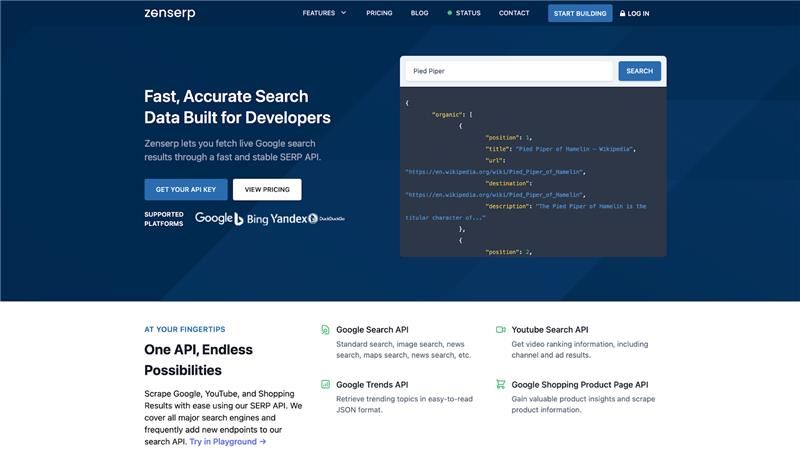
Zenserp, built by APILayer, covers Google Search, Maps, Trends, and YouTube through one API. It also supports Google News and Google Shopping, plus Bing and Yandex, under one account and API key. It supports geo-targeted searches using location strings (city, region, postal formats) and coordinates. The platform is built with developer experience as a priority, with clean REST endpoints, a Postman collection, an interactive Playground for testing queries, and documentation packed with code samples in Python, Node.js, PHP, cURL, and more.
Docs: https://app.zenserp.com/documentation
Playground: https://app.zenserp.com/playground
Example: Local (Maps) results with geo-targeting
Zenserp’s Maps search supports geo-targeted queries using a location string, and it can be refined further with coordinates. The response includes fields like place_id, star ratings, review counts, and address data in structured JSON.
					curl -X GET -G "https://app.zenserp.com/api/v2/search" \
  -H "apikey: YOUR_API_KEY" \
  -d "q=Coffee House" \
  -d "tbm=lcl" \
  -d "location=Vienna,Vienna,Austria"
					{
  "maps_results": [
    {
      "place_id": "3604572143264609499",
      "title": "Dorotheum Café",
      "address": "0 km · Spiegelgasse 16",
      "stars": 4.6,
      "reviews": 29
    }
  ]
}
Key Features:
- City and location-string geo targeting, plus coordinate-based targeting (lat/lng) for precise local SERP results
- Dedicated Maps search endpoint returning place_id, coordinates, address, star rating, and review count in structured JSON
Batch endpoint (v2/batch) for submitting large keyword-location sets in one call - Full SERP coverage across engines and endpoints (organic results, ads, featured snippets, and more depending on the endpoint)
- Multi-engine support, including Google, Bing, and Yandex under one account and API key
- Free Tier allows for 50 searches/month
Choose Zenserp if: You need a developer-friendly SERP API with strong local geo targeting (location strings and coordinates), clean Maps plus organic JSON output, and predictable pricing. Best for agencies automating multi-city reporting, SaaS teams building local rank tracking features, and developers who want fast integration with thorough documentation and a test Playground.
2. DataForSEO
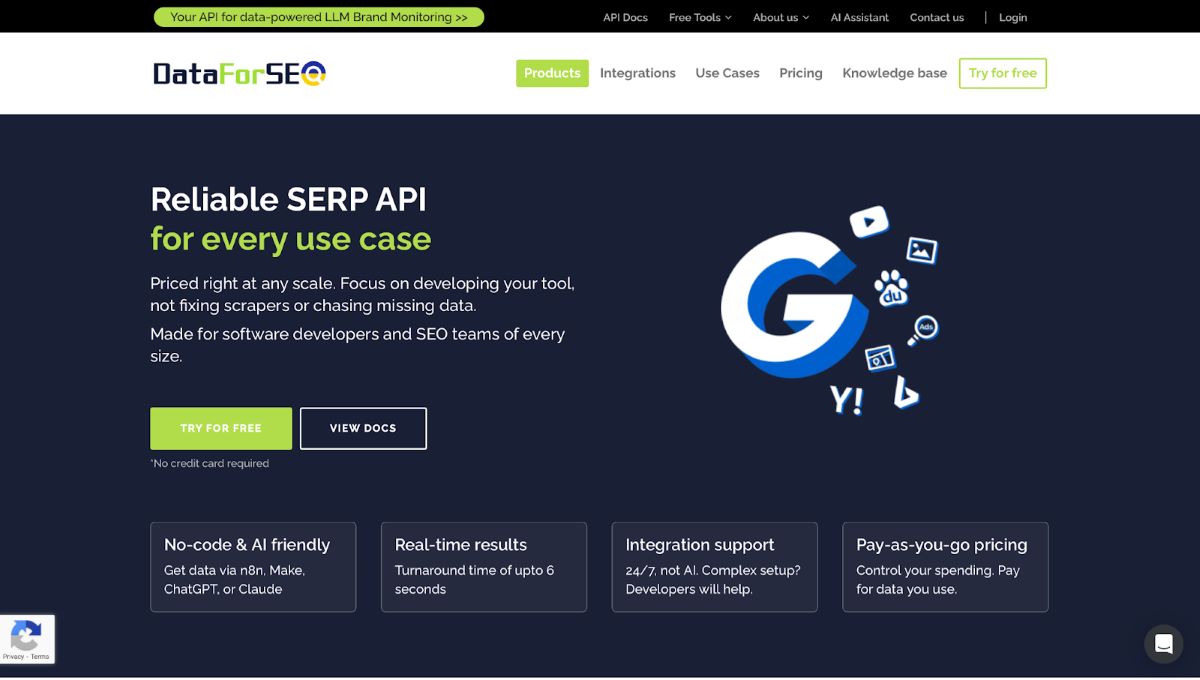
DataForSEO combines SERP data with keyword research, backlinks, and on-page analysis APIs. is a comprehensive SEO data provider that goes well beyond SERP results. The platform bundles SERP APIs with keyword research, backlink analysis, on-page SEO audits, and Google Maps data into a single API suite. For local SEO specifically, DataForSEO supports granular geo targeting at the city and ZIP level, returns Google Maps business data with GPS coordinates and reviews, and offers both live (real-time) and standard (queued) retrieval modes. The API covers Google, Bing, Yahoo, Baidu, and Yandex.
Key Features:
- All-in-one SEO API suite: SERP data, keyword research, backlinks, and on-page analysis from one provider
- Granular city and ZIP-level geo targeting with Google Maps business listings including GPS coordinates
- Live (real-time) and standard (queued) data retrieval modes for flexible workflow design
- Pay-as-you-go pricing with no fixed monthly commitment
- Multi-engine support across Google, Bing, Yahoo, Baidu, and Yandex
Choose DataForSEO if: You are building a full SEO platform and want SERP data alongside keyword intelligence and backlink analysis from one provider. Good for teams that need all their SEO data APIs under one roof and prefer pay-per-use billing over fixed plans.
3. Bright Data

Bright Data offers a SERP API backed by a massive proxy network with city-level targeting across 195 countries. Fast response times under 2 seconds. Their SERP Scraper API sits on top of this proxy infrastructure, which spans 195 countries with city-level targeting. The API delivers results in JSON or HTML, supports search types including standard web, Maps, Shopping, News, Images, and Videos, and achieves a 99.9% documented success rate.
Key Features:
- City-level geo targeting across 195 countries powered by a massive global proxy network
- Sub-2-second response times with 99.9% documented success rate and uptime
- Supports Maps, Shopping, News, Images, Videos, and standard SERP types
- Pay-per-success pricing model where you only pay for successful API responses
- JSON and HTML output formats with both synchronous and asynchronous API modes
Choose Bright Data if: You need enterprise-grade infrastructure with global reach, fast response times, and a pay-for-success billing model. Best for large organizations and teams that require high reliability across many international markets.
4. Serper
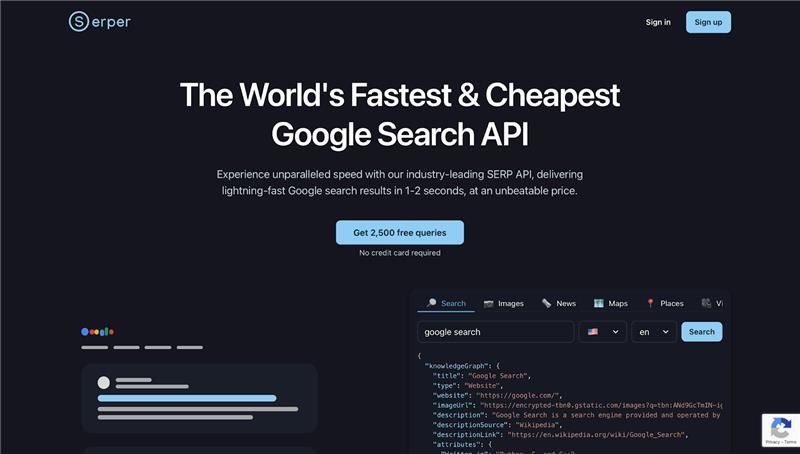
Serper is a lightweight, speed-focused Google Search API designed for developers who need fast results at low cost. The API returns real-time Google results including web, Maps, news, images, and video data, with average response times of 1-2 seconds. Serper keeps its API surface simple and focused, which makes integration quick but means fewer advanced SERP features compared to larger platforms.
Key Features:
- Very fast response times averaging 1-2 seconds per query
- Low per-query cost: $50 for 50K queries, scaling down to $0.30/1K at higher volumes
- Google Maps, News, Images, and Video support alongside standard web results
- High throughput: up to 300 queries per second for burst workloads
- Simple REST API with clean JSON output and minimal setup time
Choose Serper if: Speed and budget are your top priorities. Best for developers building MVPs, high-volume rank trackers, or dashboards where fast, affordable Google data matters more than deep SERP feature parsing.
5. ScrapingBee

ScrapingBee is a general-purpose web scraping API that also includes a dedicated SERP endpoint. What sets it apart from SERP-only tools is that it uses real browser rendering (headless Chrome) for every request, which means it handles JavaScript-heavy pages and returns results that match what a real user would see. The platform includes built-in proxy rotation, CAPTCHA handling, and delivers clean JSON output for organic SERP results. Geo targeting is available at the country level and for some cities.
Key Features:
- Real headless Chrome rendering for accurate SERP snapshots matching actual user experience
- Built-in proxy rotation and automatic CAPTCHA handling on every request
- Combined SERP and general web scraping capabilities under one API
- Clean JSON output for organic results with country-level and partial city-level targeting
- Simple API integration with clear documentation and a fast onboarding experience
Choose ScrapingBee if: You need a dual-purpose tool for SERP scraping and general web data extraction. Good for small to mid-size teams that want one provider for rank tracking and competitor page monitoring without managing separate APIs.
6. Oxylabs
Oxylabs is a Lithuania-based web intelligence platform that provides a SERP Scraper API as part of a larger data collection product suite. The platform covers Google, Bing, Yandex, and other search engines with geo targeting across 195 countries. Oxylabs uses machine learning to manage proxy rotation, generate browser fingerprints, and adapt to anti-bot measures automatically. It supports JavaScript rendering with a single parameter, automatic CAPTCHA bypassing, and scheduled scraping tasks.
Key Features:
- 195-country geo targeting with ML-driven proxy rotation and fingerprint generation
- Automatic JavaScript rendering and CAPTCHA bypass without extra configuration
- Scheduled scraping tasks for recurring rank tracking workflows
- JSON and HTML output with XPath/CSS selector support for custom parsing
- Enterprise-grade infrastructure with high concurrency and uptime guarantees
Choose Oxylabs if: You are an enterprise team, a regulated industry, or a large-scale operation that needs premium infrastructure, compliance features, and the ability to handle massive query volumes with strict uptime requirements.
Why Zenserp Fits Local SEO Tracking
Zenserp earns its position here because it directly addresses core local SEO needs without extra complexity. City-level and coordinate-based geo targeting, separate Maps and organic results in clean JSON, place_id for every Maps listing, and an async batch endpoint for bulk queries. Documentation is well-organized with an interactive Playground for testing before integration. Pricing starts free and scales transparently, making it accessible for agencies testing the product and practical for SaaS teams at volume. Explore its in-depth documentation.
Conclusion
Local SEO tracking requires geo-targeted SERP data at the city level, separate Maps and organic result sets, device control, and pricing that holds up when you multiply keywords by locations.
The right SERP API removes the guesswork. It lets you build automated pipelines pulling accurate, location-specific data into dashboards, validate local landing pages, and deliver the granular reporting clients expect. Define your keyword-location matrix, run through the checklist above, and pick the API that fits your workflow. If you want strong local geo targeting with clean structured output, Zenserp is a solid starting point.
For more developer guides and API resources, visit the APILayer Blog.
FAQ
What is a SERP API for local SEO?
A SERP API for local SEO is a programmatic interface that pulls search engine results for specific locations, devices, and languages. It returns structured data (usually JSON) covering organic rankings, Local Pack/Maps results, and other SERP features, so you can track how a business performs in specific geographic markets.
Can I track “near me” keywords with a SERP API?
Yes, if the API supports location simulation at the city, ZIP, or coordinate level. “Near me” queries depend heavily on the searcher’s location, so the API must simulate that accurately. Zenserp handles this through its geo targeting parameters.
What is the difference between Local Pack and organic results?
The Local Pack is the box of 3 business listings with a map that appears at the top of local searches. It uses Google Business Profile data, reviews, and proximity signals. Organic results are the standard blue links below, ranked by backlinks, content relevance, and domain authority. They run on different algorithms and should be tracked separately.
How many API calls do I need for local rank tracking?
Use this formula: keywords x locations x devices x frequency = monthly calls. Example: 20 keywords, 10 cities, mobile only, weekly = 800 calls/month. Plan your matrix carefully to keep costs predictable.
Does Zenserp support batch queries?
Yes. Zenserp offers an async batch endpoint on Medium plans and above. Submit large keyword-location sets and retrieve results when processing completes, which is much more efficient than individual synchronous calls for high-volume tracking.
Is there a free plan to test before committing?
Yes. Zenserp provides a free plan with 50 API requests per month. That is enough to test geo targeting, Maps results, and structured output before upgrading. Several other APIs on this list offer free tiers or trial credits too.
Recommended Resources:
- SERP API vs Proxy-Based Web Scraping: Real Cost, Reliability, and ROI
- How to Build a Scalable Web Scraping System Using Scrapestack API (2025 Guide)

