

Phone verification seems simple until you learn that half the APIs just validate data format while the other half actually send codes to verify humans. Phone verification sits right at the center of your authentication stack. It stops spam registrations and keeps your user database clean without annoying real humans. You rely on this layer to handle 2FA, block account takeovers, and stay compliant with regulations like GDPR and TCPA.
If you choose the wrong API, you risk compromising your conversion rates and burning through your monthly budget. Security teams need this to be rock solid, while product teams need it to be fast. It comes down to balancing security with a smooth user experience.
You generally have two specific ways to handle these checks. Passive validation APIs like Numverify check if a number exists, identify the carrier, and confirm the line type without the user knowing. You use this to clean up data or block fake numbers before you waste money on an SMS. Active verification APIs like Twilio and Vonage actually send an OTP code to the device. You need those active checks for login flows and high-security actions where you must prove the user holds the phone.
This comparison breaks down Numverify, Twilio, and Vonage across technical details that actually matter to engineering teams. We look at response times, documentation quality, and cost at scale to help you make a smart decision.
Table of Contents
Key Takeaways:
- Numverify handles static phone validation and carrier lookup across 232 countries at $9.99/month for 2,000 requests. Perfect for data validation and fraud detection when you don’t need to send actual verification codes.
- Twilio Verify delivers OTP across multiple channels (SMS, voice, WhatsApp, TOTP, passkeys) plus Silent Network Auth at $0.05 per successful verification. Your go-to option for dynamic 2FA and identity checks at scale.
- Vonage Verify costs €0.052 per successful verification and brings strong network APIs backed by Ericsson infrastructure. Best choice when you need cost-effective OTP verification at high volumes.
- Numverify validates number format, carrier details, and line type without any user action. Twilio and Vonage send verification codes that require user responses. These are completely different approaches to verification.
- Pick Numverify for lead validation and CRM cleanup. Choose Twilio when you need developer flexibility and multi-channel 2FA. Go with Vonage for budget-friendly high-volume verification projects.
Understanding Phone Verification: Validation vs Authentication APIs
What is Phone Number Validation?
Numverify provides a RESTful JSON API that checks phone number format, identifies carriers, and detects line types across 232 countries without any user interaction. The API returns data instantly, including validity status, local and international formats, carrier name, and whether the number is mobile, landline, or VoIP. You use this approach for lead validation, CRM data cleanup, fraud detection, and optimizing SMS routing before you spend money sending actual messages.
Get Your Free
Phone Number Validation API Key!
Numverify
Join thousands of developers using Numverify for validate phone numbers!
Get Your Free API Key!No Credit Card Required*
100 Requests Free!
What is Phone Number Verification?
Twilio and Vonage handle active authentication by delivering one-time passcodes through SMS, voice, WhatsApp, email, or Silent Network Auth. The process works in two steps: first you send a verification code to the user’s device, then you validate the code they submit back to your system. This method powers 2FA and multi-factor authentication, account creation flows, password resets, and transaction confirmations where you need proof the user actually controls that phone number.
Critical Distinction for Developers
- Validation APIs (Numverify): Passive checks that return results instantly without contacting the end user. You pay per request, regardless of whether the number is valid or not.
- Verification APIs (Twilio/Vonage): Active authentication that requires the user to receive and enter a code. You pay per successful verification, and some providers charge only when the user completes the full flow.
Numverify: Phone Number Validation & Carrier Lookup API
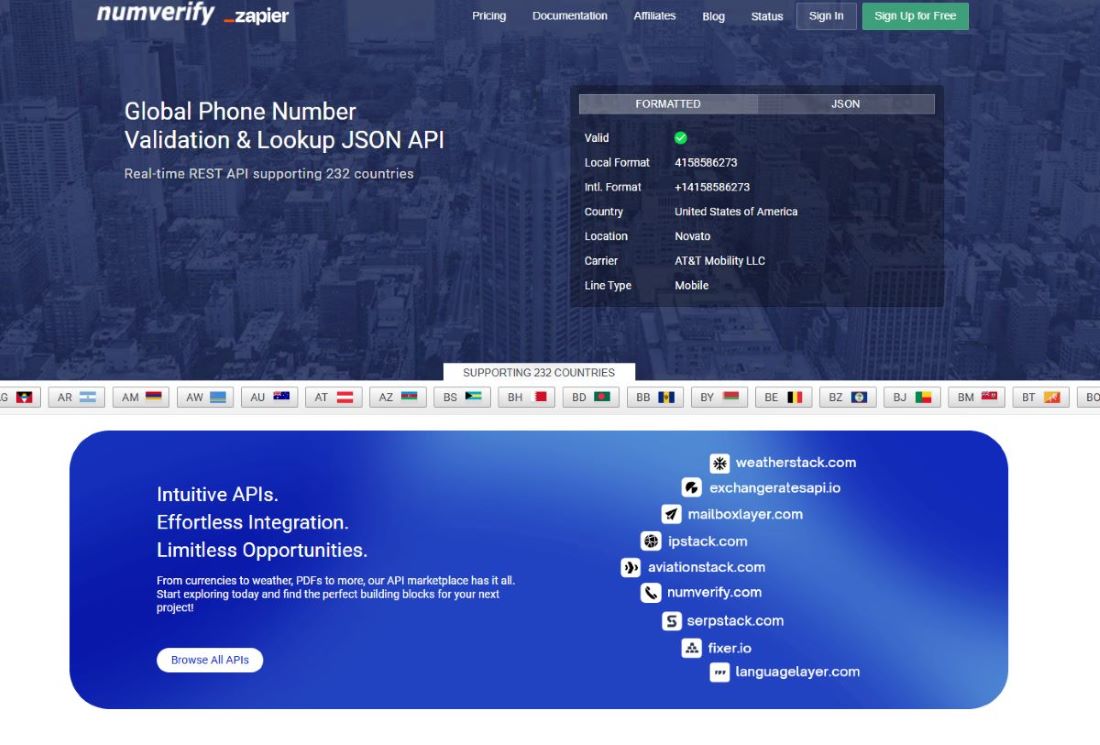
Numverify delivers a straightforward RESTful JSON API that validates phone numbers across 232 countries without sending any messages to end users. The API checks numbers in real time against international numbering plans and returns carrier details, line type detection, and location data in a simple JSON response. You get instant validation results that help you filter out fake numbers, detect fraud patterns, and keep your CRM data clean.
Core Features
- Covers 232 countries with full support for mobile, landline, VoIP, toll-free, premium rate, and special service numbers.
- Validates national phone numbers by adding a 2-digit country code parameter to your API request.
- Performs real-time validation against current international numbering plans using E.164 format standards.
- Returns carrier detection data with the telecom provider name, which helps you identify disposable or VoIP numbers commonly used in fraud.
- Detects line type (mobile, landline, VoIP, toll-free, premium rate) to ensure TCPA compliance for SMS and voice campaigns.
- Provides location data including city, state, and county when available for geographical fraud detection and personalization.
- Includes 256-bit HTTPS encryption on paid plans with JSON response format and JSONP callback support.
- Tracks your API usage daily or monthly and sends automatic notifications when you approach your request limit.
Key Strengths
- Single-endpoint REST API delivers instant responses without complex workflows, webhooks, or multi-step processes.
- Costs 10 to 20 times less than OTP verification APIs for validation-only use cases at roughly $0.005 per request versus $0.05+ per verification.
- Server-side validation runs invisibly without user interaction, SMS delivery delays, user input requirements, or failed message deliveries.
- VoIP detection and line type identification come included in every response at no extra cost while competitors charge separately for carrier lookup.
- Fixed monthly plans with transparent overage rates eliminate surprise charges from message delivery failures or international SMS premiums.
- Returns sub-second response times compared to 5 to 30 second SMS delivery windows required for OTP-based verification.
- Integrates with the broader APILayer ecosystem including IP geolocation, currency, and weather APIs for unified billing and support.
- Works best for developers who need to validate phone number authenticity, detect fraud patterns, and optimize SMS campaigns without sending phone verification codes.
Enterprise Use Cases
- Enriches CRM data by validating and enhancing phone numbers in Salesforce or HubSpot with carrier and location metadata.
- Flags VoIP numbers and detects carrier mismatches such as a US user with an Indian carrier to prevent fraud.
- Optimizes SMS routing by identifying line types to avoid sending text messages to landlines and maintain TCPA compliance.
- Assigns lead scoring and risk scores based on carrier reputation, line type, and location data for better qualification.
Pricing Structure

- Free tier provides 100 requests per month for testing and proof-of-concept projects.
- Paid plans start at Starter ($9.99/month for 2,000 requests), Basic ($14.99/month for 5,000 requests), Professional ($59.99/month for 50,000 requests), and Enterprise ($129.99/month for 250,000 requests).
- Annual billing saves up to 15% compared to monthly subscriptions across all plan tiers.
Twilio: Multi-Channel OTP Verification API
Twilio provides a managed verification API that handles OTP delivery across seven different channels without requiring you to build separate integrations for each communication method. The platform automatically routes phone verification attempts through the most reliable channel based on real-time carrier data and location intelligence. You get enterprise-grade 2FA infrastructure with built-in fraud prevention, PSD2 compliance, and fallback logic that keeps verification rates high even when primary channels fail.
Core Features
- Supports 7 pjone verification channels including SMS, voice calls, WhatsApp, email, TOTP (Authy and Google Authenticator), passkeys, and push notifications.
- Silent Network Auth validates users through carrier networks without sending SMS messages, eliminating delivery costs for mobile users.
- Automatic Channel Selection uses AI-powered routing to pick the most reliable delivery method based on recipient location and carrier performance data.
- Verification Service architecture lets you create reusable service configurations with custom friendly names, code lengths, and message templates.
- Built-in rate limiting and fraud prevention includes configurable attempt limits to stop abuse before it drains your budget.
- PSD2 compliance provides regulatory-ready strong customer authentication for financial services and payment processing.
- Lookup integration performs pre-verification phone number validation to catch invalid numbers and reduce failed delivery attempts.
Key Strengths
- Most comprehensive channel support in the market with 7 verification options including cutting-edge methods like passkeys, TOTP, and Silent Network Auth that competitors lack.
- Industry-leading developer experience backed by detailed documentation, 7 official SDKs, a massive community with over 1 million GitHub repositories, and TwilioQuest gamified learning platform.
- Advanced intelligent routing automatically selects optimal channels and upgrades SMS to RCS when available to maximize deliverability using real-time carrier and location data.
- Enterprise-grade reliability delivers 99.95% uptime SLA through extensive global carrier partnerships and redundant infrastructure.
- Unified CPaaS ecosystem enables seamless integration with Twilio’s SMS, voice, video, email, and programmable communication APIs for comprehensive workflows.
Enterprise Use Cases
- Multi-factor authentication adds 2FA or MFA to login flows with automatic fallback support when primary verification channels fail.
- Account registration verifies phone ownership during signup to eliminate fake accounts and improve user database quality.
- Transaction confirmation secures high-value purchases for e-commerce and fintech platforms by requiring user verification before processing.
- Password reset confirms user identity before allowing credential changes to prevent account takeover attacks.
- International operations leverage global carrier coverage with localized message templates across 180+ countries.
Pricing Structure
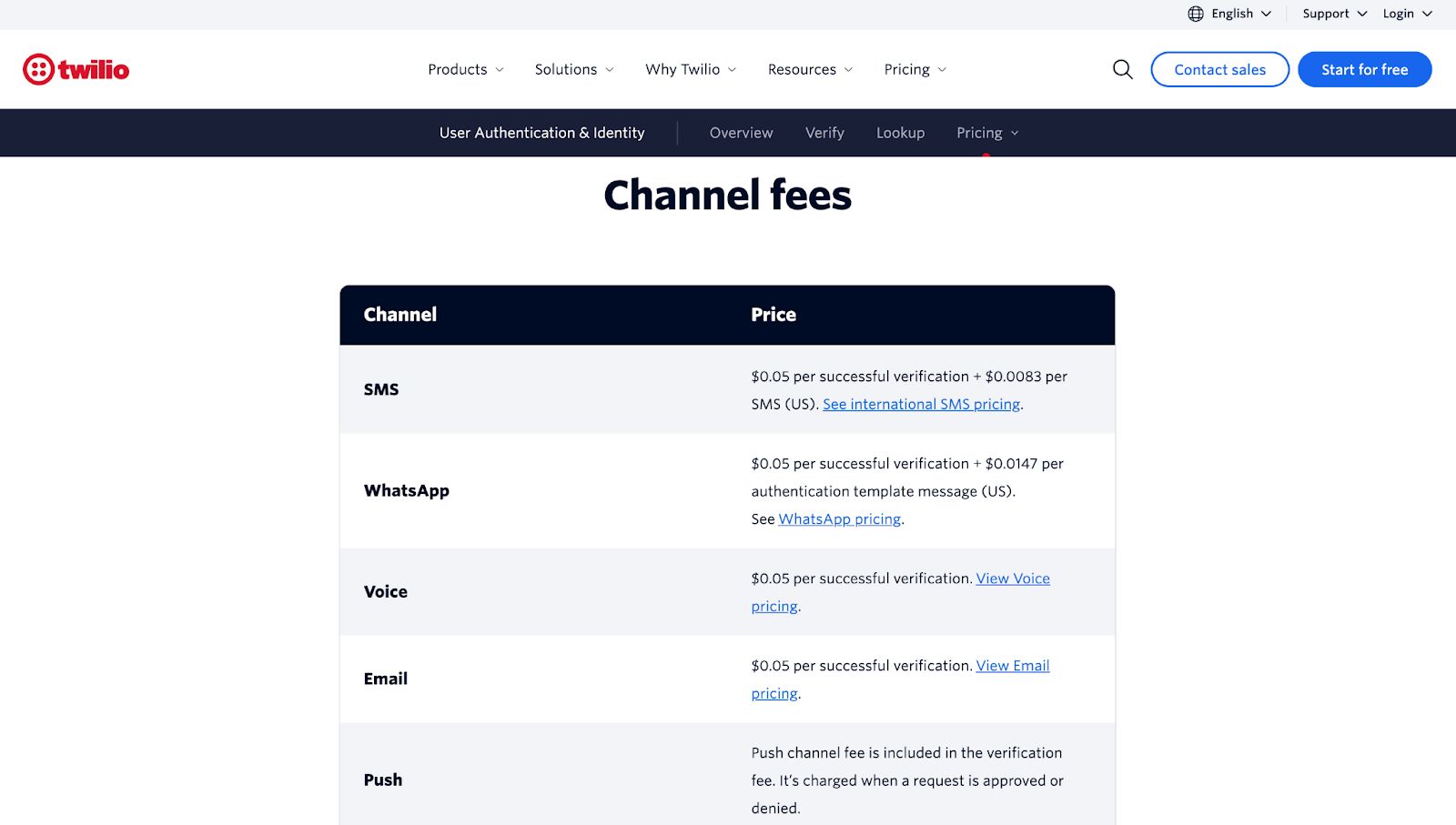
- Verify API charges $0.05 per successful verification attempt across all channels.
- SMS rates add $0.0079 per message in the US on top of the base Verify API fee, with international pricing varying by country.
- Voice rates cost $0.05 per successful verification.
- WhatsApp pricing is $0.05 per successful verification + $0.0147 per authentication template message (US).
Vonage: Cost-Effective Enterprise Verification API
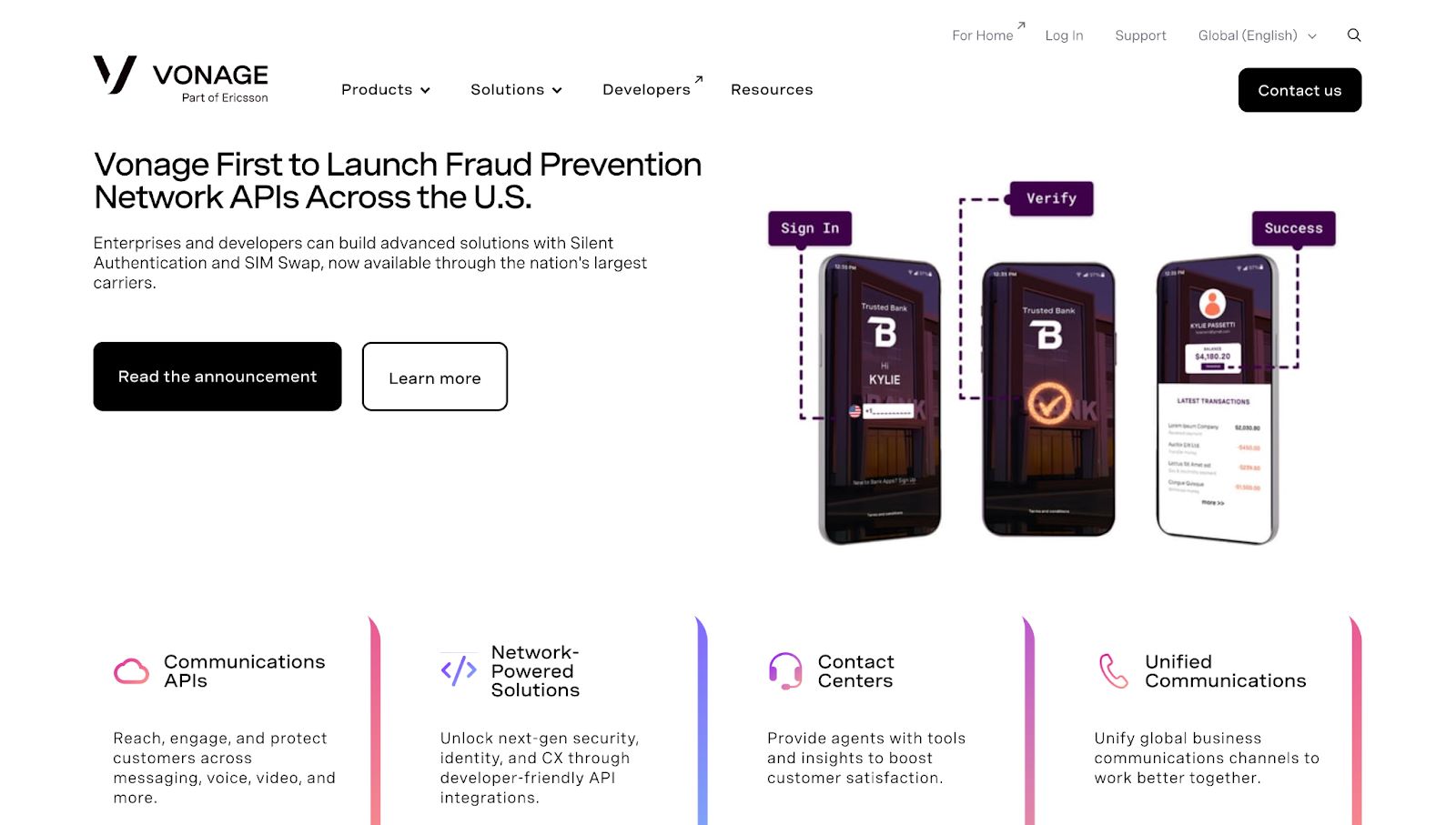
Vonage Verify delivers enterprise-grade phone verification through direct carrier integrations backed by Ericsson’s network infrastructure. The platform stands out with unique Network APIs that provide SIM swap detection, mobile number portability checks, and network experience management through direct carrier partnerships. You get multi-channel OTP delivery combined with advanced fraud prevention tools at pricing that undercuts competitors by roughly 10% per successful verification.
Core Features
- Ericsson-backed network APIs provide direct carrier integrations for enhanced network-level phone verification and real-time mobile intelligence.
- Multi-channel support includes SMS, voice calls, Silent Network Auth, and Flash Call callback phone verification for faster authentication.
- Embedded AI enables conversational AI integration for voice-based verification workflows and intelligent routing decisions.
- Fraud prevention tools deliver dedicated anti-fraud mechanisms and risk scoring to identify suspicious patterns before they cost you money.
- Vertical expertise offers industry-specific solutions for finance, healthcare, and education with pre-built compliance frameworks.
- CPaaS platform integration connects seamlessly with Vonage UCaaS and CCaaS products for unified communication workflows.
Key Strengths
- Network API exclusivity makes Vonage the only major provider offering SIM swap detection, mobile number portability checks, and network experience management through CAMARA-standard carrier partnerships.
- Higher community satisfaction shows G2 reviewers rating Vonage’s integration ease and community support quality above competitors despite a smaller ecosystem.
- Flash Call innovation provides callback-based verification unique to Vonage that delivers faster and more cost-effective verification in supported regions.
- Vertical-specific solutions include pre-built compliance frameworks and workflows for finance, healthcare, and education that reduce custom development time and regulatory risk.
Enterprise Use Cases
- High-volume verification operations benefit from cost-sensitive pricing when you need to process millions of verifications monthly.
- Telecom applications leverage network APIs for SIM card verification and mobile number portability checks to prevent fraud.
- Regulated industries like finance and healthcare use built-in compliance frameworks that meet GDPR, PSD2, and HIPAA requirements.
- Global operations save money with lower per-message costs in international markets compared to competitors.
- Contact center integration combines verification with Vonage CCaaS for unified customer authentication across support channels.
Pricing Structure
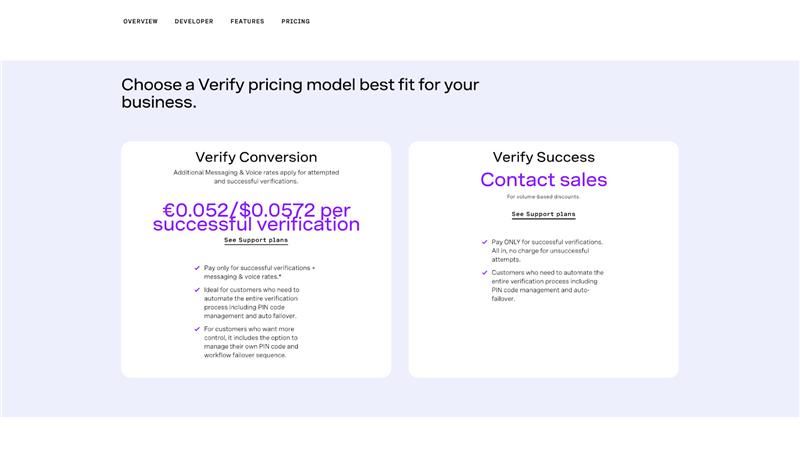
- Verify API charges €0.052 (approximately $0.057) per successful phone verification under the Verify Conversion model.
- SMS pricing for US LVN starts as low as €0.00735 per message, significantly cheaper than Twilio’s equivalent rates.
- Messages API costs €0.00110 per delivered message across multi-channel delivery options.
- Voice PSTN calls run at €0.01314 per minute for authentication via voice channel.
Detailed Comparison Table of Numverify, Twilio and Vonage
Features | Numverify | Twilio | Vonage |
Primary Function | Phone validation & carrier lookup | OTP verification multi-channel | OTP verification + network APIs |
Verification Type | Passive (instant data return) | Active (requires user input) | Active (requires user input) |
Channel Support | N/A (validation only) | SMS, voice, WhatsApp, email, TOTP, passkeys, push | SMS, voice, Flash Call, Silent Network Auth |
Global Coverage | 232 countries | 180+ countries | 190+ countries |
Pricing Model | Per-request with overage fees | Per-successful-verification + channel costs | Per-successful-verification + channel costs |
Starting Price | $9.99/mo (2K requests) | $0.05/verification + SMS/voice fees | €0.052/verification + SMS/voice fees |
Free Tier | 100 requests/month | No free verification tier (pay-as-you-go) | No free verification tier (pay-as-you-go) |
Response Time | < 1 second (validation) | 5-30 seconds (SMS delivery) | 5-30 seconds (SMS delivery) |
Carrier Detection | Yes (name + line type) | Via Lookup API (separate service) | Built-in with network APIs |
VoIP Detection | Yes (line_type field) | Via Lookup API add-on | Yes (network-level) |
Best For | Lead validation, CRM hygiene, fraud detection | Developer flexibility, omnichannel 2FA, scale | High-volume verification, cost optimization, telecom use cases |
Integration & Developer Experience Comparison
API Complexity & Time to First Call
Numverify:
- Single-endpoint REST API requires you to append the phone number to the URL and parse a simple JSON response with no complex workflow.
- First successful call takes 5 to 10 minutes including API key setup and basic request formatting.
Twilio:
- Three-step workflow requires creating a verification service, sending the verification code, and checking the submitted code.
- First implementation takes 30 to 45 minutes including service configuration and testing both send and check endpoints.
Vonage:
- Similar workflow to Twilio but adds optional network API features like SIM swap detection for advanced use cases.
- Basic implementation takes 30 to 60 minutes for standard verification flow setup.
Documentation Quality & Developer Resources
Numverify:
- Interactive API documentation provides clear examples with response object descriptions and error code references.
- Developer-friendly interface offers straightforward integration guides that minimize setup complexity.
Twilio:
- Extensive documentation includes guided tutorials, detailed error troubleshooting, and milestone-based onboarding guides.
- Active community resources include 1 million plus GitHub repositories, developer forums, and TwilioQuest gamified learning platform.
Vonage:
- Comprehensive documentation features Postman collections for quick API testing and OpenAPI specifications for each endpoint.
- Higher G2 ratings for community support quality and integration ease compared to competitors despite smaller ecosystem size.
Error Handling & Debugging
Numverify:
- Clear three-digit error codes paired with plain-text info messages make troubleshooting straightforward.
- JSON response format includes validity status and detailed field-level error information.
Twilio:
- Detailed error codes come with comprehensive troubleshooting guides and status webhooks for async debugging workflows.
- Real-time monitoring through Verify Events tracks authentication events from OTP deliverability to approved verifications.
Vonage:
- Standard HTTP status codes combine with carrier-level error details provided through network APIs for deeper diagnostics.
- Request status field in API responses returns zero for success with specific error codes for different failure scenarios.
Accuracy, Reliability & Performance
Data Accuracy
- Numverify: Regular updates to international numbering plans with carrier database maintained by APILayer infrastructure.
- Twilio: Direct carrier integrations enable real-time HLR and HNI lookups with mobile number portability detection through the Lookup API.
- Vonage: Carrier-grade infrastructure uses adaptive routing based on historical delivery success rates and real-time network conditions.
Global Coverage & Reach
- Numverify: Validates phone numbers across 232 countries supporting all number formats including international, national, and local variations.
- Twilio: Covers 180+ countries for SMS and 60+ countries for voice with localized sender IDs and regional number support.
- Vonage: Reaches 200+ countries with automatic country-specific compliance handling and carrier-specific routing optimizations.
Delivery Success Rates
- Numverify: Achieves 100% success rate since instant validation happens server-side without requiring message delivery to end users.
- Twilio: Delivers 98%+ SMS success rates with automatic voice fallback and intelligent channel prioritization when primary delivery fails.
- Vonage: Maintains 95%+ first-attempt delivery rate using multi-path routing and real-time fallback mechanisms across carrier networks.
Latency & Response Times
- Numverify: Returns validation results in under 100ms average response time globally with 99.94% availability.
- Twilio: SMS delivery takes 2 to 60 seconds depending on carrier network while API acknowledgment happens immediately upon request.
- Vonage: Averages 5 to 30 seconds for standard SMS delivery with faster response times when using Silent Authentication methods.
Security, Compliance & Enterprise Features
Data Encryption & Security Standards
- Numverify: 256-bit HTTPS encryption protects all API connections with no storage of validation requests for privacy protection.
- Twilio: End-to-end encryption with SOC 2 Type II, ISO 27001, ISO 27017, and ISO 27018 certifications ensuring data remains encrypted at rest and in transit.
- Vonage: Enterprise-grade encryption with secure code management and no client-side exposure of sensitive authentication data.
Regulatory Compliance
- Numverify: GDPR-compliant data processing with encrypted storage and no PII retention beyond validation requirements.
- Twilio: Full PSD2 and SCA support with GDPR compliance, HIPAA-eligible services, and TCPA compliance for SMS campaigns.
- Vonage: PSD2 ready with dynamic linking support for strong customer authentication, GDPR compliance, and automatic carrier-specific compliance handling.
Fraud Prevention Capabilities
- Numverify: Enables fraud detection through carrier and line type analysis to filter VoIP numbers, disposable numbers, and suspicious patterns.
- Twilio: Built-in Fraud Guard includes SMS pumping protection, configurable rate limiting, and anomaly detection to stop abuse.
- Vonage: Fraud detection tools with botnet prevention and step-up authentication for suspicious numbers flagged by network APIs.
Enterprise SLAs & Support
- Numverify: Standard email support with Platinum support on higher tiers offering dedicated account teams and 99.9% uptime guarantee.
- Twilio: 24/7 support with dedicated account managers for Enterprise customers, 99.95% SLA, and active community forums with extensive documentation.
- Vonage: 24/7 enterprise support includes technical account management and dedicated Slack channels for direct engineering access.
Use Case Recommendations: Which API to Choose
When to Choose Numverify
Best For
- Pre-validation before SMS sending: Reduce costs by validating numbers before triggering expensive SMS delivery charges and improve campaign ROI.
- Database hygiene & CRM cleansing: Normalize international numbers and remove invalid entries through automated batch validation for customer databases.
- Lead qualification: Filter out VoIP and disposable numbers in marketing funnels to prioritize high-quality leads
- High-volume validation: Applications needing to check hundreds of thousands of numbers monthly without per-verification user.
- interaction costs.
- Budget-conscious startups: Maximum value at minimal cost with $0.40 per 1,000 validations compared to $50+ for OTP verification at the same scale.
Real-World Examples
- E-commerce platforms: Validate checkout phone numbers to ensure SMS order updates reach mobile devices and reduce delivery failures.
- Marketing automation tools: Score leads by phone quality using carrier type and line detection to prioritize outreach efforts.
- Customer service portals: Normalize contact information across international formats for consistent database records.
- SMS marketing platforms: Pre-qualify recipient lists to avoid sending messages to landlines and maintain TCPA compliance.
Get Your Free
Phone Number Validation API Key!
Numverify
Join thousands of developers using Numverify for validate phone numbers!
Get Your Free API Key!No Credit Card Required*
100 Requests Free!
When to Choose Twilio Verify
Best For
- Regulated industries: Fintech, healthcare, and government applications requiring PSD2 and SCA compliance with dynamic linking support.
- Multi-channel authentication: Apps needing SMS plus voice plus WhatsApp plus email fallbacks for maximum verification success rates.
- High-security applications: Banking, payments, and sensitive data access requiring enterprise-grade 2FA with fraud prevention.
- Global enterprise deployments: Applications with users across 100+ countries needing localized sender IDs and regional routing.
- Developers already using Twilio: Leverage existing infrastructure and expertise with seamless CPaaS platform integration.
Real-World Examples
- Banking apps: Transaction verification with PSD2 compliance using dynamic linking to show amount and recipient in OTP messages.
- Healthcare portals: HIPAA-compliant 2FA for patient data access with automatic voice fallback when SMS fails.
- Gig economy platforms: Prevent fake accounts during driver and worker onboarding with multi-channel verification.
- SaaS applications: Enterprise SSO requirements with customizable code length and PSD2-ready strong customer authentication.
When to Choose Vonage
Best For
- Cost optimization: Applications processing high volumes benefit from €0.052 per successful verification with Verify Success pricing.
- Success-based billing optimization: Reduce costs by only paying for successful verifications under the Verify Success model for enterprise volumes.
- Telecom-specific features: Leverage network APIs for SIM swap detection and mobile number portability checks to prevent fraud.
- International focus: Better pricing in Europe, Latin America, and Asia with competitive rates in emerging markets.
- UCaaS/CCaaS integration: Combine verification with Vonage contact center or unified communications for streamlined workflows.
Real-World Examples
- High-growth applications: Platforms scaling rapidly with unpredictable verification volumes benefit from pay-as-you-go pricing.
- Ride-sharing apps: Verify drivers and passengers at scale with cost-effective pricing for millions of monthly verifications.
- Messaging apps: Phone-based identity verification with Flash Call for faster authentication in supported regions.
- Dating apps: Prevent bots and spam accounts using carrier-grade network APIs with fraud detection.
Conclusion
Your choice between Numverify, Twilio, and Vonage comes down to what you actually need. If you’re validating phone data before storing it in your database, Numverify gives you instant validation with carrier and line type detection for a fraction of the cost. When you need active verification with OTP delivery, Twilio and Vonage handle multi-channel authentication with SMS, voice, and app-based options.
Most developers get better results using both: run phone numbers through Numverify first to catch invalid entries and enrich your data, then send OTPs through Twilio or Vonage only to verified mobile numbers. This approach cuts your verification costs and improves delivery rates since you’re not wasting API calls on landlines or disconnected numbers.
Start with 100 free validations per month on Numverify to test your implementation. The API takes minutes to integrate, and you’ll immediately see cleaner data flowing into your systems.
Sign up for free 100 validations/month at Numverify and check the API documentation to get started in under 10 minutes.
FAQs
What’s the actual difference between Numverify and Twilio/Vonage?
Numverify validates phone numbers instantly without contacting the user and tells you if a number is real, what carrier it uses, and whether it’s mobile or landline. Twilio and Vonage send actual verification codes (OTP) to users through SMS, voice, or other channels and wait for them to enter the code back.
Can I use Numverify to send OTP codes to users?
No, Numverify only checks if a phone number is valid and returns carrier data without sending anything to the user. You need Twilio Verify or Vonage Verify if you want to send actual OTP codes for two-factor authentication.
Which API is cheaper for validating 10,000 phone numbers monthly?
Numverify costs about $50 for 10,000 validations on their Professional plan, while Twilio charges $500 for 10,000 verifications at $0.05 per successful attempt. If you only need to check if numbers are valid before storing them in your database, Numverify saves you 90% compared to OTP verification.
Should I use both validation and phone verification APIs together?
Yes, most developers get better results running numbers through Numverify first to catch invalid entries and filter out landlines, then sending OTP codes through Twilio or Vonage only to verified mobile numbers. This cuts your verification costs because you skip expensive SMS delivery to disconnected or fake numbers.
How long does integration take for each API?
Numverify takes 5 to 10 minutes since it’s a single REST endpoint where you append the phone number and parse JSON. Twilio and Vonage need 30 to 60 minutes because you have to set up verification services, handle the send code flow, then check the code users submit back.
Does Numverify validate international phone numbers?
Yes, Numverify covers 232 countries and validates numbers in international, national, and local formats. You just pass a 2-digit country code parameter with your request and it checks the number against current international numbering plans for that region.
What other APIs does APILayer offer besides Numverify?
APILayer provides IP geolocation (ipstack), currency exchange rates (fixer), weather data (weatherstack), aviation flight tracking (aviationstack), email validation, and several other data APIs that developers commonly need. All APIs share the same account dashboard and billing system, so you can add multiple services without managing separate subscriptions.
Recommended Resource :
- Phone Validation & Carrier Lookup: Why Your Business Needs Numverify API
- OpenAI Function Calling: How to Connect LLMs to The Best Free APIs (2025)
- APIs Without AI Are Just Dead Endpoints
